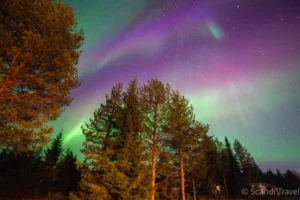
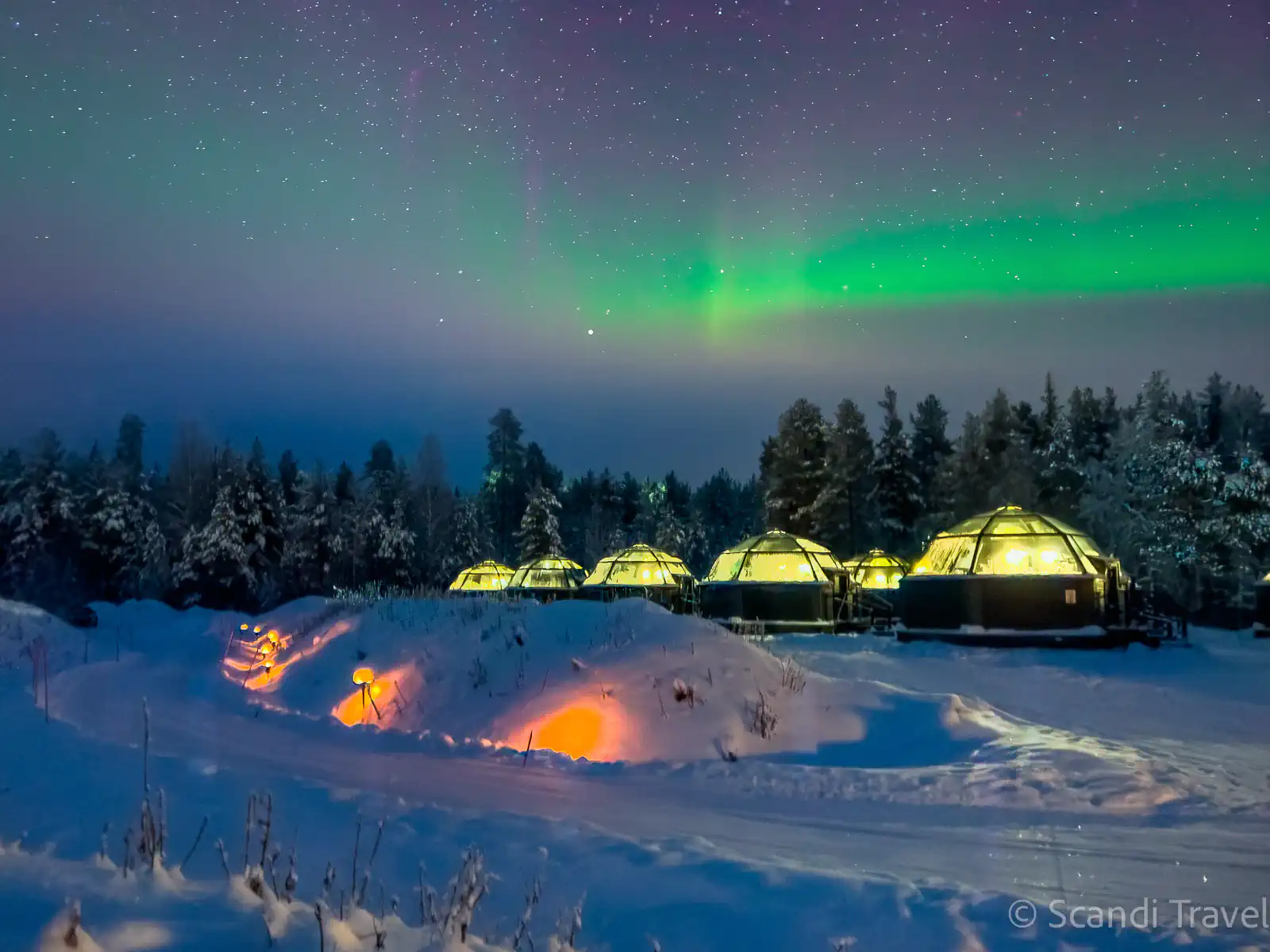
It is 3 a.m. On the other side of the glass above your bed it reads −24 °C, dry snow skating across the fell somewhere out in the dark, and you are lying under a duvet in a T-shirt watching a pale green ribbon unspool over the spruce tops. It hangs still for a moment. Then it folds, gathers speed, and within a minute the whole northern sky is rippling.
This is the moment glass igloos were built for. Not the photo — though you will get the photo — but catching the aurora without leaving your bed or freezing to reach it. A glass igloo in Lapland is about the only way to sleep directly beneath the Northern Lights and stay warm and quiet while you do it.
This guide gives you the honest version: what a glass igloo actually is, when to come in winter 2026–2027, where to base yourself from Saariselkä to Inari, and what to do once you are there. The team at Scandi Travel lives in Finland and has been taking guests north for more than a decade — so no postcards, just how it really works.
What a Glass Igloo in Lapland Actually Is 🌌
The short version: it is a small, warm cabin with a dome of heated glass where the roof would normally be. You lie in bed, the sky is right above you, and there is no cold and no frost on the glass.
That word — heated — is the whole point. The glass over the bed is warmed from the inside, so at −30 °C outside it does not fog up or ice over. Without that, you would simply be staring at a frosted crust. The first glass igloos appeared in the Saariselkä area: this is where Finland put up its first glass domes and, in effect, started the entire trend.
Two expectations are worth resetting straight away. First, “igloo” is a loose word here — this is not a hut built from snow blocks but a proper heated room with thermal glass, a bed, and usually a private toilet and shower (not always, so check when you book). Second, the Northern Lights are never guaranteed. A glass roof improves your odds — you can watch the sky all night and won’t sleep through a burst at 2:40 a.m. — but it cannot change the weather or the sun.
One more thing. A glass igloo is not the cheap-and-simple choice. It is a premium stay you travel for on purpose. If it makes no difference to you which window you watch the stars through, a regular cabin with a sauna gives you more room. You book a glass igloo for one thing: the sky over the bed.
When to Go: The Aurora Season Month by Month 📅
Glass igloos run roughly from late August to late April — the aurora season. But “you can go” and “best time to go” are not the same thing. Here is how the winter really looks.
- September–October. The aurora is already out and the nights are dark, but there is little snow or none at all. The picture is less of a postcard: green ribbons over dark forest rather than over a white plain. Quieter, though, and calmer.
- November. The in-between month. Snow settles and kaamos arrives — the polar night in the far north, when the sun does not rise at all. It is dark almost around the clock, which means a huge window for the lights.
- December–January. The most Christmassy and the most booked-out stretch. Deep snow, everything in frost, no sun at all in the far north. Cold (−15 to −25 °C is normal) and busy. Book four to nine months ahead.
- February–March. Many guides call this the best window. The nights are still long and dark and the snow is at its deepest, but the daylight is coming back — so you can do huskies and reindeer in the light and chase the aurora at night. Statistically, activity runs higher around the equinox (about 20 March).
- Late March–April. Snow is still on the ground, the cold is gentler, and there is plenty of daylight. The aurora is still out, but the window of darkness narrows week by week.
Now the sun, because no aurora conversation is complete without it. The peak of Solar Cycle 25 has already passed — it came in late 2024. Don’t let that put you off: the strongest auroral shows often land in the declining phase, a year or two after the peak. Forecasts expect elevated activity to hold through 2026–2027, especially in the weeks around the equinoxes. In plain terms, the window for a glass igloo Lapland trip is still wide open, and winter 2026–2027 is a genuinely good one.
Where to Stay: The Best Regions for a Glass Igloo
The aurora-hunter’s rule is simple: the further north you go and the further you are from town lights, the better your chances. Glass igloos are scattered all across Finnish Lapland, from Rovaniemi on the Arctic Circle to the deep north near Inari. Three regions are where most people end up choosing.
Saariselkä — the classic, the original experience
If you want the original, this is it. Saariselkä sits around 250 km north of the Arctic Circle, half an hour from Ivalo airport, between Urho Kekkonen National Park and the Hammastunturi wilderness. Translation: wilderness on every side and almost no light pollution — ideal conditions for the aurora. It is the most recognised address for glass igloos, with solid infrastructure, smoke saunas, and husky safaris on the doorstep.
Inari — for going further north and quieter
Inari is the far north, the heart of Sámi country and a vast frozen lake. People come here when Saariselkä feels too busy. Less bustle, higher latitude, a stronger sense of real Arctic — and, as a rule, better aurora odds simply because of how far north you are.
Rovaniemi — if you are travelling with children
Rovaniemi sits right on the Arctic Circle and is the capital of Lapland, with direct flights, the Santa Claus Village, and glass-roofed options such as forest rooms with panoramic windows. Your aurora chances here are a touch slimmer than in the far north — it is further south and closer to town lights — but the logistics are easy, and for a family with small children that often matters more than one extra night under a green sky.
What to Do — and What to Pack 🧳
The igloo is a base, not the whole trip. Days are for activities, nights are for the aurora. Here is what usually goes into a Scandi Travel winter program.
- Husky safari 🐕. A team of huskies pulls your sled through silent forest. A loud, eager start — then total quiet once you are moving.
- Reindeer and sleigh 🦌. Slower, calmer, closer to the Sámi tradition.
- Guided aurora hunt. A guide drives you to wherever the sky is clearest tonight and reads the Kp forecast. The glass igloo is good, but mobility sometimes wins.
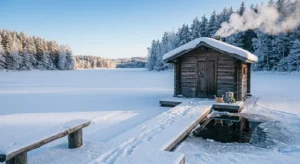
- Sauna and ice hole. The Finnish classic: a scorching sauna, then a step into freezing water. Not for everyone — if you truly hate the cold, skip it. But it is worth a try.
- Snowshoeing and cross-country skiing. The quiet way to get away from every light and into real darkness.
What to bring for −30 °C: thermal base layers (top and bottom), a thick mid-layer (fleece or down), a windproof outer shell, wool socks, warm gloves with thin liners underneath, a hat, a balaclava or buff, and winter boots with room for a thick sock. Many tours hand out a warm overall and felt boots for the activities — confirm when you book. For shooting the aurora, bring a tripod and a spare battery: in the cold, batteries drain several times faster.
Glass Igloo Lapland FAQ
Are the Northern Lights guaranteed?
No, and anyone who promises a guarantee is bluffing. The aurora depends on solar activity and a clear sky. A glass roof improves your chances — you are under the sky all night and won’t sleep through a burst — and the declining solar cycle keeps activity high through 2026–2027. But the honest answer is that nobody can guarantee it.
Isn’t it cold in the igloo at night?
No. It is an insulated, heated room; you will not be cold even at −30 °C outside. The only place you will feel the cold is in your eyes, when you read the thermometer on the far side of the glass.
Can I bring small children?
Yes, with a sensible schedule. For families with little ones, Rovaniemi is often the easier base: simple logistics, plenty of warmth, and Santa next door. See our family Lapland tours.
How many nights should I book?
Usually one or two in the igloo itself. It is a compact category built around the experience rather than space, and very few people spend a week under the dome. As the high point of a trip — yes; as the whole trip — rarely.
Ready to Plan Your Night Under the Northern Lights?
A glass igloo is one of those experiences you cannot fake or “watch on YouTube instead.” You can see a hundred photos of the aurora and still freeze the first time a green ribbon folds over the bed right above you, with −24 °C on the far side of the glass. If you would rather not piece the logistics together yourself — the flights, the transfers, the right igloo in the right region, the activities around it — the team at Scandi Travel has been building these trips for over a decade and takes the load off your hands. That leaves you with the only thing that matters: lying back and looking up. 🤝
- 🌌 Browse our Northern Lights tours
- 🛷 See our winter Lapland adventures — igloos, huskies, reindeer
- 💬 Contact us for a personal offer within 24 hours