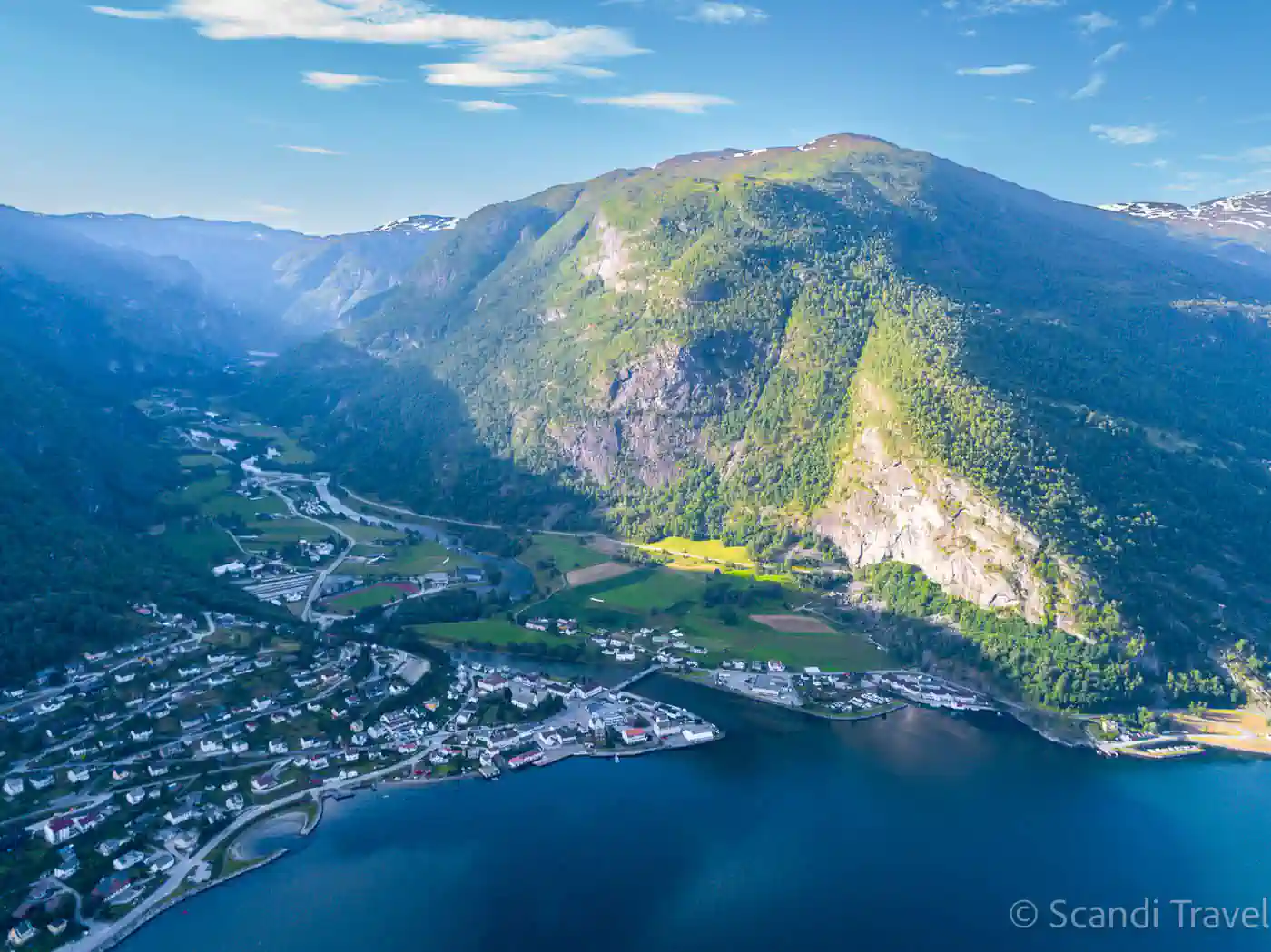
It’s almost midnight on the Aurlandsfjord, the engine has been cut, and the water sits so still it holds the mountains upside down. The sun hasn’t set. It won’t — not properly, not for weeks — and the light has gone the colour of weak tea and warm copper. High on a ledge that looks impossible to reach, a single farm clings to the rock, where someone, generations ago, decided this was a sensible place to keep goats.
This is Norway in summer, and almost nobody outside Scandinavia talks about it. The country gets filed under winter — aurora, snow, polar dark — and that’s a shame, because the warmer half of the year might be the better one. ☀️
From late May to late August the fjords turn green and gold, the waterfalls run fat with snowmelt, and the day simply refuses to end. In this guide we’ll cover when to go, which fjords actually earn their reputation, where to base yourself beyond the postcards, and what to put in your bag — drawn from the routes our team at Scandi Travel runs every season from our base here in the North.
Why Norway in Summer Beats the Winter Version 🌅
Winter Norway is genuinely spectacular. But it asks a lot of you — short days, hard cold, a fair bit of waiting indoors for the weather to cooperate. Summer asks almost nothing and gives back more.
The obvious gift is light. Above the Arctic Circle (66.5°N) the sun stays up around the clock for weeks, and even in the south the “nights” in June are really just a few hours of soft dusk. You can hike at 10 PM, cruise a fjord at midnight, and never once reach for a head-torch. The days stretch so wide that you stop planning around daylight entirely — which, after a winter at home, takes some getting used to.
Then there’s the simple matter of access. Mountain roads that vanish under snow for half the year open up. The high passes, the hairpin switchbacks, the coastal ferries — all running. Waterfalls that hang frozen and silent in February are roaring by June, fed by meltwater pouring off the high plateaus.
And it’s warmer than people expect. Bergen and Oslo sit comfortably in the high teens and low twenties Celsius through July, while the fjord country smells of warm pine, cut grass, and salt. Norwegians have a word for the national instinct to be outdoors at any excuse — friluftsliv, roughly “open-air living” — and by July the whole country seems to be practising it at once.
When to Visit Norway in Summer: Month by Month ☀️
“Summer” covers a lot of ground this far north. Late May feels nothing like late August. Here’s how the season actually breaks down.
- Late May. The shoulder. Orchards in Hardanger are in blossom, the crowds haven’t landed, and prices are softer. Snow can still cap the high passes, and a few mountain roads open only at month’s end. In Lofoten, the midnight sun begins around 25–28 May.
- June. The sweet spot for many. Long light, full waterfalls, everything open, and the heaviest crowds still a few weeks off. The solstice around 20–21 June is the peak of the midnight sun — at the North Cape the sun stays above the horizon roughly from mid-May to late July.
- July. Peak season, peak warmth, peak crowds. This is when Norwegians take their own holidays, so popular spots and ferries fill up — book early. The payoff is the most reliable weather of the year and a country in full bloom.
- August. The quiet exhale. Crowds thin after the first week, the light slowly returns to having real nights, and the first hint of autumn touches the high ground by month’s end. Bilberries and cloudberries ripen in the uplands.
If you want one rule of thumb: go in June for the light and the space, July for the warmth and certainty, late August for value and calm. For exact local forecasts, Norwegians trust yr.no, run by the national meteorological institute.
The Fjords: The Heart of a Norwegian Summer 🌊
You can see a fjord in winter. You really should see one in summer. The difference is the water — hundreds of falls, threads of white dropping a thousand feet down sheer black rock, fed by snow that’s melting fast on the plateaus above. Two fjords carry UNESCO World Heritage status, and they’re the ones to prioritise.
Nærøyfjord — the narrow one
The Nærøyfjord is the slim, dramatic arm of the vast Sognefjord, and at points it pinches to barely 250 metres wide while the mountains on either side rise to 1,400–1,600 metres. Cruising it feels less like sailing and more like drifting down a flooded canyon. Most boats here now run silent and electric, so the only sounds are meltwater, gulls, and the occasional waterfall hitting the surface. It’s the single most photogenic stretch of water in the country. 📸
Geirangerfjord — the dramatic one
If Nærøyfjord is the narrow one, the Geirangerfjord is the theatrical one. Its headline act is the Seven Sisters waterfall: seven separate ribbons of water plunging some 250 metres straight into the fjord, with abandoned mountain farms perched on ledges that defy belief. It gets busier than Nærøyfjord in July, but for good reason — nothing else in Norway quite matches the scale of it.
The easy way: Oslo to Bergen by rail and water
The classic route threads the fjords together without a car. You take the Bergen Line up over the wild Hardangervidda plateau, switch to the Flåm Railway — one of the steepest standard-gauge lines anywhere, with a five-minute stop at the 93-metre Kjosfossen waterfall — then cruise the Nærøyfjord and carry on to Bergen by bus and train. A full day of moving scenery, almost no effort, and barely a moment without a view worth photographing.
Done independently, it takes some planning around timetables and connections, and high-summer trains sell out. If you’d rather not assemble the puzzle yourself, our 6-day Norwegian fjords tour from Oslo to Bergen handles the trains, the cruise, and the hotels end to end, so the only decision left is which side of the carriage to sit on. More options live under our spring, summer and autumn tours. 🚂
Beyond the Fjords: Where Else to Go 🏔️
The fjords are the centrepiece, but a Norwegian summer has range. Here’s where to point yourself if you have extra days.
Flåm
A tiny village tucked deep in the Aurlandsfjord, at the foot of the mountains — the terminus of the Flåm Railway and the launch point for Nærøyfjord cruises. Flåm itself is barely two streets, a waterside brewery, and a quay, but as a base for the night it’s invaluable: you can catch an early boat before the day-trippers arrive, then walk or cycle the old railway construction road, the Rallarvegen, as it switchbacks down from the mountains. 🚲
Bergen
The gateway to the western fjords, and a proper city in its own right. The colourful timber warehouses of Bryggen, the old Hanseatic wharf, are UNESCO-listed and worth an unhurried afternoon with a coffee. Bergen is also famously the rainiest city in Europe — locals barely own umbrellas, they just keep good coats by the door — so pack accordingly and don’t let a grey morning derail the day.
The Lofoten Islands
Further north, the Lofoten Islands are jagged granite peaks rising straight out of the sea, with white-sand beaches at their feet and red fishermen’s cabins, rorbuer, lining the harbours. In summer they sit under the midnight sun and the water turns an improbable turquoise. This is hiking, sea-kayaking, and slow-living country, and one of the few places that genuinely lives up to its photographs.
Tromsø and the true midnight sun
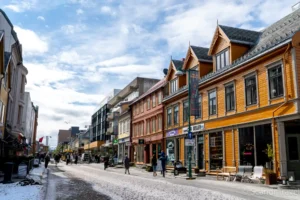
If the midnight sun is what you’re really chasing, Tromsø is the easiest place in the world to find it — an Arctic city of 77,000 with direct flights from across Europe, where the sun stays above the horizon from roughly 20 May to 22 July. Midnight hikes and even midnight golf are local pastimes.
For the hikers: Preikestolen and Trolltunga
Norway’s two most famous day hikes only open up properly in summer, once the snow clears. Preikestolen — the flat cliff-top “Pulpit Rock” 600 metres above the Lysefjord — is the more manageable of the two. Trolltunga, the sliver of rock jutting out over Ringedalsvatnet, is a long, demanding full day. Neither is something to attempt in poor weather, but on a clear July morning they’re unforgettable.
What to Pack for Norway in Summer 🥾
The cardinal rule of a Norwegian summer is that the weather changes its mind. You’ll get sun, wind, and rain in a single afternoon, and the temperature drops the moment you gain altitude or step into fjord shade. Dress in layers and you’ll be fine.
- A proper rain shell. Waterproof and windproof, not a flimsy poncho. This is the one thing you cannot improvise on, especially around Bergen. ☔
- Layers, not bulk. A base layer, a fleece or light wool mid-layer, and that shell will carry you from 8 °C to 25 °C without fuss.
- Real walking shoes. Even casual fjord stops involve uneven, often wet ground. Leave the white trainers at home.
- An eye mask. Sounds trivial; isn’t. With the sun up at midnight, blackout helps you actually sleep. Some hotels in the north have good curtains, but don’t count on it.
- Sunglasses and sunscreen. The sun is low and constant, and it reflects hard off water and snow. 🕶️
- A reusable bottle. Tap water in Norway is excellent, and on the trail you can often drink straight from the streams.
One cultural note: Norway’s allemannsretten, the right to roam, lets you walk, camp, and forage across most uncultivated land. Treat it with respect — pack out what you pack in, give farms and homes a wide berth — and the whole country opens up to you.
Norway in Summer: Your Questions, Answered
When is the midnight sun in Norway in 2026?
It depends how far north you go. In the Lofoten Islands it runs roughly from 25–28 May to mid-July; in Tromsø, from about 20 May to 22 July; at the North Cape, from mid-May to late July. On Svalbard, far to the north, the sun doesn’t set from mid-April until late August. The summer solstice on 20–21 June is the peak everywhere. 🌞
Is summer really the best time to see the fjords?
For most travellers, yes. The waterfalls are at full flow, every road and ferry is running, and the long light gives you far more hours to explore. Winter has its own stark beauty, but if you want the classic green-and-blue fjord postcard, come between June and August.
How bad is the rain?
On the west coast — Bergen especially — rain is part of the deal, even in July. It rarely ruins a trip if you’re dressed for it, and the fjords are arguably more atmospheric with low cloud snagging on the peaks. Inland and in the far north you’ll generally find drier, brighter weather.
Can I combine Norway with Finland or Sweden?
Easily, and many of our travellers do. A summer trip can run from the Norwegian fjords across to Finnish Lapland for the midnight sun, or take in several capitals at once. See our Nordic multi-country tours or the 9-day Finland-to-Norway Arctic adventure for ideas.
How far ahead should I book?
For July travel, three to six months is sensible — Norwegians take their own holidays then, and the best hotels and fjord cabins sell out early. June and late August are a little more forgiving, but the standout properties still go quickly.
Ready to Plan Your Norwegian Summer?
A Norwegian summer doesn’t shout. It works on you slowly — the midnight light, the sound of meltwater, the strange calm of a fjord that’s barely changed in a thousand years. You come for the scenery and leave having quietly recalibrated what a good day feels like. And if you’d rather spend that time looking out the window than wrestling with train timetables, the team at Scandi Travel has been building these journeys for over a decade — we handle the logistics so you can simply be there. 🤝