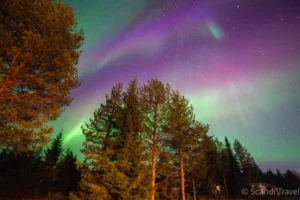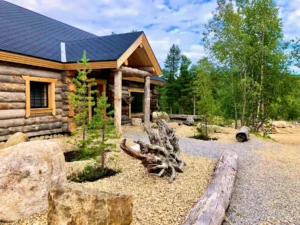
Picture this: 24 December, eight in the evening. You step out of a log cabin near Saariselkä, and the snow under your boots squeaks the way it only squeaks at −22 °C — dry and bright. A pale green ribbon hangs above the spruce line, thin as silk, trembling almost imperceptibly. From inside the cabin: the scent of mulled wine and cinnamon. A husky barks somewhere in the distance. Nobody is in a hurry. ❄️
This is Christmas in Lapland 2026 — not a winter holiday, but a quiet initiation into a slower, larger world. If you’re considering it for the coming season, there’s good news and there’s bad news.
Good: 2026–2027 marks the solar maximum, and the Northern Lights will be brighter and more frequent than they’ll be again until around 2036. Bad: the best chalets and glass igloos for 23–27 December are already 60–70% booked. In this guide, we’ll cover when to come, what’s worth doing, and why our team at Scandi Travel has built our Lapland Christmas itineraries the way we have over the past decade.
Why Christmas in Lapland Doesn’t Feel Like Anywhere Else
The short version: for Finns, this isn’t a tourist attraction. It’s a home holiday. And that’s exactly why it works.
Finland is the official residence of Joulupukki — the Finnish Father Christmas, who lives not in a shopping centre but on Korvatunturi fell, near the eastern border. Children across Finland write him letters, and on 24 December — Jouluaatto, Christmas Eve — he visits Finnish homes in person. He isn’t a man in a costume on a stage. He’s a figure Finnish children grow up with from birth.
When you arrive in Rovaniemi or Saariselkä in December, you’re not stepping into a set. You’re stepping into a living tradition. The hotel staff member who shakes your child’s hand — that same person was skating with their own grandchild last weekend. The Sámi guide taking you out on the reindeer sleigh wears the same hat his grandfather wore.
There’s one more thing that’s hard to explain until you arrive. December in Lapland is kaamos — the polar night. The sun doesn’t rise above the horizon. But “polar night” is misleading: it isn’t darkness in the ordinary sense. It’s a blue, lilac, violet “non-night” that lasts most of the day. At noon, it’s pink. At three in the afternoon, violet. By five, the sky turns ink-blue. Finns call this sininen hetki, the blue hour. And it genuinely changes your sense of time.
When to Come: December Week by Week 📅
December isn’t one long season. It’s four very different weeks. Choose by what you want out of the trip.
- 1–10 December. Lowest prices, fewest tourists — but snow can still be thin in southern Lapland around Rovaniemi. Husky and reindeer activities are running, and aurora is possible. Best for couples after quiet who aren’t tied to school holidays.
- 11–20 December. Snow is solid, temperatures −10 to −20 °C. Prices rise but aren’t yet peak. A good compromise for full winter Lapland without the Christmas rush. Excellent window for aurora: calm nights, clear skies.
- 21–27 December — peak. The actual holiday, the main family tours, the full Santa programme, top prices (often +60–80% over November). Book 9–12 months ahead. Many hotels serve a traditional Christmas Eve menu: roast ham (kinkku), potato and carrot casseroles, glögi with almonds and raisins.
- 28 December – 2 January. New Year peak. Slightly less family-driven than Christmas week, equally busy. Suits couples and adult groups. Levi and Ylläs have fireworks and après-ski parties.
If you want aurora, Santa, and a softer price tag — aim for 18–21 December. We call this the “golden window” inside the team: the decorations are up, Joulupukki’s office is running, school holidays haven’t started in most countries, and prices sit 25–35% below peak.
When to Book (And Why You Should Start Now)
Short answer: 9–12 months ahead, if you want Christmas in a glass igloo or in one of the better lodges.
The longer answer needs unpacking. Finland doesn’t have many glass igloos. Fewer than 200 across the whole country, and roughly 60% of them go to tour operators by March or April for packaged Lapland tours. If you try to book an igloo for 24 December in August, you’ll probably see an empty calendar and conclude “no luck this year.” It isn’t bad luck. The inventory was distributed five months earlier.
The same applies to the best husky safaris (3+ hours with lunch in a kota — a traditional Sámi tent shelter) and to private meetings with Joulupukki himself at Korvatunturi through the Wilderness Hotel programme. Their December schedule typically closes by May.
What we recommend on timing:
- January–March. Optimal window for booking next Christmas. Best igloo availability, prices not yet inflated.
- April–June. Still possible, but igloos and villas for 23–27 December are partly gone. Good cottages and 4★ hotel rooms remain.
- July–September. A window for flexible travellers. Expensive, choice limited — but if you can shift to 18–21 December or 27–31 December, options exist.
- After October. A gamble. Cancellations happen, but don’t plan around them.
If you’re reading this in spring 2026 with Christmas 2026 in mind, this is the last sensible moment to start. By September, you’ll have to be flexible on dates or location.
7 Christmas Experiences in Lapland Worth Coming For 🦌
The activities our guides keep putting back into itineraries — because they work.
- Husky safari, 2–3 hours. 🐕 The start is deafening: twelve dogs that can’t wait for “go” bark loud enough to make your ears ring. A minute in, total silence — just the hiss of runners on snow. Don’t confuse it with the 15-minute “ride” inside Santa’s Village. Different thing entirely.
- Reindeer sleigh ride with a Sámi guide. Slow, smoky (the rest stop involves a fire in a kota, reindeer soup, foraged berries), no theatrics. The most rooted experience of the trip.
- Meeting Joulupukki in his office. Not on a stage — in a study. You walk into a room and he’s alone, speaks seven languages, asks your child about school. The whole thing takes 5–7 minutes. Children remember those minutes for years.
- A night in a glass igloo. If you’re lucky, the aurora over your bed. If you’re unlucky, the kind of star field that, in the total darkness, looks like the dome of a planetarium. Complete bad luck isn’t really an option.
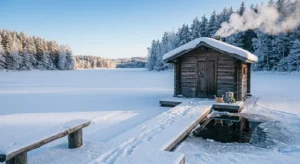
- Sauna on a frozen lake, ice hole next door. 🔥 Finns claim it rewires your brain chemistry. They aren’t lying. Water at +1 °C, sauna at +85 °C, and 30 seconds of snow and silence between them.
- A Finnish Christmas Eve dinner. Roast ham, carrot and potato casseroles, rosolli (beetroot and herring salad), glögi with almonds and raisins. Calm, no speeches.
- Aurora hunt with a guide. 🌌 Not “step outside the hotel and look.” A proper guide reads the aurora forecast, KP index, and cloud cover, then drives the group to the right spot — sometimes 60 km from base. With a guide, your chance of seeing the lights across three nights is roughly 85%. Without one, closer to 40%.
Santa Claus Village: An Honest Guide
The question we get most often — so without dancing around it.
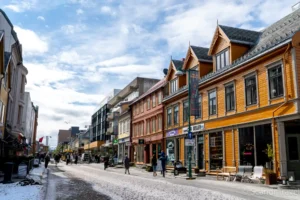
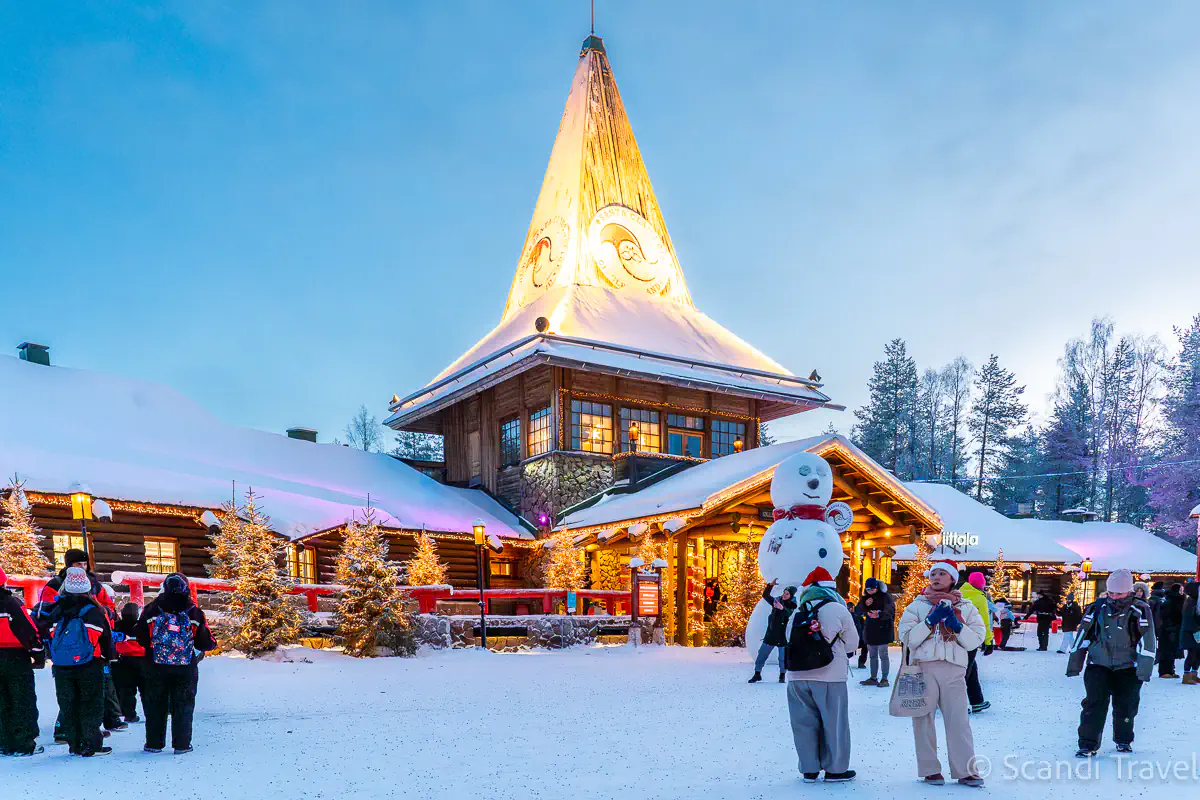
Santa Claus Village sits directly on the Arctic Circle, 8 km from central Rovaniemi. Entry is free, open year-round. Inside: Santa’s main office (free, but photos and video cost €40), the Joulupukki Post Office, restaurants, shops, a reindeer yard, a husky park.
What’s actually worth your time:
- Meeting Joulupukki in his office — yes, fully
- The Main Post Office — fun for kids; you can post a card scheduled to arrive on Christmas Day
- Crossing the Arctic Circle line — for the photo
Our standard advice: 2.5–3 hours at the Village in the morning is enough. Spend the rest of the day on full activities with proper operators in the surrounding forests. This is exactly the structure of our 6-Day “Finnish Fairy Tale” tour from €2,115 — half a day at the Village, the rest on huskies, reindeer, and aurora hunts.
Frequently Asked Questions
Is it safe to bring a three-year-old to Lapland?
Yes, with a sensible schedule. Long outdoor activities (more than an hour straight at −20 °C) tire a toddler quickly. We build trips with short outdoor blocks and regular returns to a warm space.
Is seeing the Northern Lights guaranteed?
Nobody can guarantee it. But 2026–2027 is the solar maximum, and across a 5–7-night trip with a guide, the chance of seeing the lights climbs above 85%. The further north (Inari, Utsjoki), the better the odds.
Can we have Christmas in Lapland without the Santa programme?
Of course. Plenty of couples and adult groups come for aurora, sauna, and silence. Saariselkä and Inari fit that mode better than Rovaniemi.
What about cost?
Christmas week is peak. A family trip of 6 nights in a 4★ hotel, with all transfers and 4–5 activities, runs €2,100–€4,500 per person depending on accommodation and programme.
Can we combine Lapland with Helsinki?
Yes — and we run several variations of this combination. After 2 days in Helsinki, you can transfer to Rovaniemi either by a 1-hour flight or, more atmospherically, on the Santa Claus Express — the overnight sleeper train that leaves Helsinki Central in the evening and arrives in Rovaniemi at breakfast. Then several nights in Lapland. Many of our guests pick the train: you fall asleep among southern pines and wake up to snow. Ideal if it’s your first time in Finland.
Ready to Plan Your Lapland Christmas in 2026?
Christmas in Lapland is impossible to fake. There are no painted backdrops behind the corner — the snow is real, the cold is real, the silence in the forest is real. Joulupukki, the one who’ll shake your child’s hand, actually lives in this country, speaks several languages, and isn’t in a rush. The aurora isn’t “promised in a brochure” — it’s a physical phenomenon in the sky that either happens or doesn’t, and either outcome is honest.
If you’d rather not piece the logistics together yourself, our team at Scandi Travel has been building these journeys for over 12 years.