The first thing to understand about Finnish sauna culture is that it is not a treatment. It is a room where a Finn washes, thinks, says nothing for twenty minutes, settles an argument, closes a deal and — historically — was born. Finland has roughly three million saunas for 5.6 million people. There are more saunas than cars. You will find them in one-bedroom flats, fire stations, office basements, the parliament building, Finnish embassies abroad and the president’s official residence.
In December 2020, UNESCO added sauna culture in Finland to its list of the Intangible Cultural Heritage of Humanity. The wording is precise, and it matters: not the building, but the culture — what people do in there, and what it means to them.
This guide covers what actually happens behind that wooden door. How a real sauna is built, what a Finn does step by step, which unwritten rules are genuine and which are tourist myths, what avanto is and whether to get in, and where to find a proper public sauna in Helsinki, Tampere and Lapland. 🇫🇮
Why Finnish Sauna Culture Isn’t a Wellness Trend
The most common mistake a visitor makes is arriving with spa expectations: dimmed lights, piped music, eucalyptus oil, a therapist waiting on the other side of the door. None of that is coming. A classic Finnish sauna has no music, no coloured lighting and no scent beyond birch and hot stone.
The reason is simple. The sauna predates the wellness industry by about a thousand years. Until the middle of the twentieth century it was the cleanest room in a Finnish house — the only space that could be heated to something close to sterile. Families did their laundry in it, smoked their meat in it, treated the sick in it and delivered babies in it. There are still people alive in Finland who were born in a sauna.
That history shows in the language. An old proverb runs: “Jos sauna, viina ja terva ei auta, tauti on kuolemaksi” — if sauna, spirits and tar don’t cure it, the illness is fatal. It sounds like a joke, and it half is. But look at the order: the sauna comes first.
The same root produced what Finnish diplomats openly call sauna diplomacy. For decades the foreign ministry has built saunas into its embassies and held quiet conversations in them — a practice President Urho Kekkonen turned into a personal instrument of statecraft. The logic is straightforward. You cannot wear a suit in a sauna, you cannot look at your phone, and it is very hard to keep using official language while sitting on a wooden bench with nothing on.
What this means for you as a guest: when a Finnish family, a host or a guide invites you into the sauna, it is not an entertainment item on the schedule. It is a way of saying you’re one of us. Declining is perfectly allowed — explaining why is polite.
The Anatomy of a Real Sauna: Löyly, Kiuas and Vihta
A handful of words carry most of the meaning in Finnish sauna culture, and they are worth knowing before you open the door.
- Löyly. The burst of steam that rises when you ladle water onto the hot stones. This is the central word of the whole tradition. Löyly has character — it can be soft or harsh, and Finns discuss it about as seriously as a sommelier discusses wine. In older usage the same word meant spirit, or breath of life.
- Kiuas. The stove. Wood-burning is the real thing; electric is the norm in city flats and hotels; a savusauna, or smoke sauna, heated without a chimney, is the top of the hierarchy.
- Lauteet. The wooden benches. Heat stacks upward, and the difference between the bottom and top bench can easily be 30 °C. Beginners sit low, and nobody thinks less of them.
- Vihta or vasta. A whisk of young birch branches. Same object, two names: vihta in western Finland, vasta in the east — still a source of good-natured argument.
- Kiulu and kauha. The bucket and the ladle. The only tools in the room.
- Saunatonttu. The sauna elf. Believing in him is optional; behaving decently in his room is not.
On temperature: the Finnish Sauna Society recommends 80–100 °C, while Visit Finland gives a typical range of 70–90 °C. Humidity stays low between ladles, which is why 90 °C in a Finnish sauna is easier to sit in than 50 °C in a Turkish steam room. The heat is dry, and it moves.
The savusauna deserves its own paragraph. It is heated with wood for six to eight hours, with the smoke escaping through the door and a vent rather than a chimney. The embers are then raked out, the room is aired, and only then do people go in. The walls are black, the löyly is heavy and soft, and the whole room smells of smoked timber. Ask a Finn privately which sauna is best and most of them will say this one.
How Finns Actually Use a Sauna, Step by Step
From outside it looks improvised. It isn’t. Finnish sauna culture has a shape — heat, cool, repeat — and everything else is detail.
- Undress completely. In the changing room, not in the hot room.
- Shower first. This is not a suggestion. You go in clean.
- Take a towel and sit on it. The towel is a seat cover, not clothing. Many public saunas hand out disposable seat covers at the door.
- Sit still for five to fifteen minutes. Lower bench if it’s your first time. There is no prize for the top bench.
- Throw water on the stones — after asking. One ladle changes the room for everybody in it, so a quick “Saako heittää?” (“May I throw?”) is normal courtesy.
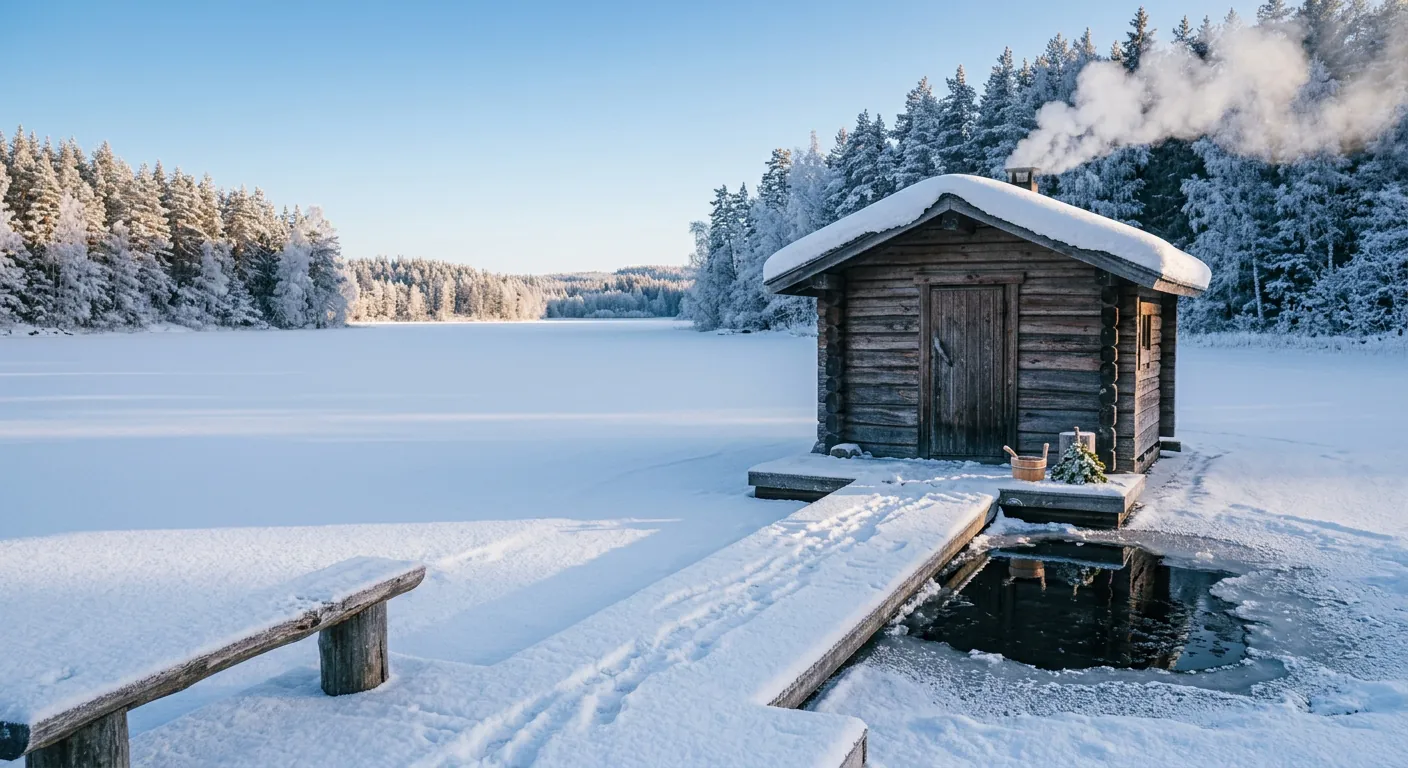
- Go out and cool down. A shower, cold air on the terrace, a lake, the sea, snow, or a hole cut in the ice. In winter Finns stand outside in a towel at −20 °C and say nothing. That part is the point, not a stunt.
- Repeat two to four times. The cycles, not one long sitting, produce the wrung-out, weightless feeling people come back for.
- Sit down with a drink. Saunakalja — the post-sauna beer — is an institution. Water, juice or kotikalja work just as well. Grilling sausages on the stove is common and entirely serious.
The vihta needs one clarification, because the photos are misleading. You do not beat anybody with it. You slap gently at your own shoulders, back and legs to move blood to the skin and release the smell of birch. Fresh whisks are made in early summer, when the leaves are young; the rest of the year Finns use frozen ones from the summer batch. Your skin goes pink, and the smell stays with you all evening.
Sauna Etiquette for Visitors: Eight Rules and Three Myths 🤝
Almost nothing in Finnish sauna culture is enforced. It is simply what everybody does, which is a stronger form of rule.
- Naked is standard; a swimsuit is a compromise. Public saunas are divided — miehet for men, naiset for women — and in those sections people are nude, without any sexual charge whatsoever. Mixed saunas (sekasauna) and modern city saunas like Löyly in Helsinki require a swimsuit. If you are unsure, ask at the desk. It is a completely ordinary question.
- Families go in together. Parents take children into the sauna as a matter of course. Bottom bench, short sittings, plenty of water afterwards.
- The phone stays in the locker. Partly manners, partly physics: electronics do not survive 90 °C and steam.
- Ask before you ladle. Half a bucket thrown onto the stones the moment somebody settles on the top bench is the sauna equivalent of grabbing the thermostat in someone else’s car.
- Don’t arrive drunk. Alcohol, heat and a cold plunge are behind nearly every bad sauna story there is. The beer comes afterwards.
- Know where washing happens. In old public saunas such as Rajaportti or Kotiharju, washing is part of the ritual. In modern design saunas, you wash in the shower and the hot room is for sitting.
- Leave when you want to leave. Nobody times you and nobody notices who goes out first.
- Close the door quickly. Every slow door drops the löyly. This is the one thing you may actually get told off for.
Three myths worth dropping
“You must sit in silence.” You don’t. Silence is welcome and nobody finds it awkward, but conversation is normal too — just at a lower volume than a bar.
“Hotter is better.” Treating temperature as a competition marks you instantly as a beginner. The World Sauna Championships were discontinued after a competitor died in 2010, and Finnish opinion on that has been settled ever since.
“There’s a minimum time you have to manage.” There is no standard, no target and nothing to prove. Five minutes is a sauna.
Avanto and What the Heat Does to You ❄️
An avanto is a hole cut in lake or sea ice; avantouinti is winter swimming. For a Finn, sauna followed by a plunge is not an extreme sport. It is an ordinary Tuesday evening in February.
The physics are worth knowing. Water under the ice sits at roughly 0 to +2 °C whether it is −5 or −25 outside. Between the top bench and that water there can be a 90-degree difference. The first seconds knock the breath out of you, and that reaction is normal rather than a warning sign.
How to take your first dip
- Use the ladder. Go down slowly, holding the rail. Nobody jumps.
- Breathe out loud and slowly. Controlling your breath is the entire technique.
- Ten to thirty seconds is plenty. There is no benefit whatsoever in staying longer on a first attempt.
- Keep a wool hat on. Finns swim in them. It looks odd and it works.
- Get out, go back into the heat, repeat. The second dip is always easier than the first.
Who should skip it
If you have high blood pressure, a heart rhythm disorder, any cardiac condition, or you are pregnant, this is not something to improvise — talk to your doctor before the trip rather than deciding at the edge of the ice. Our guides raise this with guests before the group ever reaches the lake, and nobody is ever pushed in. A cool shower gives you the same cycle.
What twenty years of Finnish data show
The most cited research on the subject comes from Docent Jari Laukkanen‘s group at the University of Eastern Finland, published in JAMA Internal Medicine in 2015. The team followed more than 2,000 middle-aged men for about 20 years. Men who used a sauna four to seven times a week were around 63 % less likely to suffer sudden cardiac death than men who went once a week, and sittings longer than 19 minutes were associated with a lower risk than sittings of about 11 minutes.
The caveat usually cut from the headlines: this is an observational study of Finnish men in one region. It shows association, not proof of cause, and Laukkanen himself describes the possible mechanism cautiously — lower blood pressure and better vascular elasticity. Finns were doing this for a thousand years before the data arrived, and will carry on regardless of the next paper.
Where to Experience Finnish Sauna Culture: Helsinki, Tampere and Lapland 🔥
Hotel saunas are fine. Public saunas are where the culture actually lives, and three places are worth planning around.
Helsinki 🏙️
Löyly is the country’s most photographed sauna: a sculptural timber building on the waterfront with three wood-fired rooms, a restaurant and sea access all year. Swimsuit required, booking essential, and by some distance the easiest place to start if you have never done this before.
Kotiharjun Sauna has been running since 1928 in the Kallio district and is the last traditional wood-heated public sauna in central Helsinki. No design, tiled washing hall, separate men’s and women’s sides, and regulars sitting on the kerb outside in towels to cool off. This is the real urban version.
Kulttuurisauna, opened in 2012, was the first new public sauna built in Helsinki in half a century — spare Finnish-Japanese architecture, a strict quiet policy and steps straight into the sea. Sompasauna is the opposite end of the scale: free, volunteer-built, no staff, no service. You bring wood and heat it yourself.
A city sauna evening slots neatly into any of our Nordic city break packages, and we can book the busier places before you land.
Tampere — sauna capital of the world
Tampere has held the title Sauna Capital of the World since 2018, with backing from the International Sauna Association and the Finnish Sauna Society, and the region counts more than 70 public saunas.
Rajaportti, opened in 1906 in the Pispala district, is the oldest public sauna still working in Finland, still heated with wood. Wooden benches, a café in the yard, and neighbours who have been coming for forty years. Kuuma and the floating FLOU on Lake Pyhäjärvi are the modern counterpart — sauna, restaurant and water views. Rauhaniemi and Kaupinoja are the people’s version: lakeside public saunas with an ice hole kept open all winter, where the queue for the ladder forms happily at −20 °C.
Lapland 🌌
In the north, Finnish sauna culture is built into the trip rather than chosen separately. Nearly every cabin, hotel and glass igloo has one, and the evening sequence — heat, then snow or ice water, then the sky — is a large part of what people come for.
Two things exist here that don’t exist further south. The first is the sauna-and-aurora combination: stepping out to cool down in a towel and finding a green band folding over the treeline is an ordinary February evening in Inari or Saariselkä, which is exactly why we steer guests toward accommodation with its own sauna and a clear view north. Our 8-Day Lapland Northern Lights tour from €3,720 is built around evenings of that shape, and the 6-Day Finnish Fairy Tale to Rovaniemi from €2,115 is the shorter way in. If you are weighing up where to sleep, our guide to glass igloos versus log cabins in Lapland goes through it properly.
The second is the smoke sauna on a frozen river bank — heated for half a day, used for one evening, with the ice hole recut every few days. Around Inari and Rovaniemi these are part of the programme on our Winter Lapland Adventures rather than a novelty add-on, and they pair naturally with our Northern Lights tour packages.
Frequently Asked Questions
How hot is it, and is it safe?
Usually 70–90 °C with low humidity, which is safe for a healthy adult. If you have a heart condition, high blood pressure, or you are pregnant, speak to your doctor first. Drink water before and after; leave the alcohol until afterwards.
Do I really have to be naked?
In gender-separated sections, yes, that is the norm and it carries no charge at all. In mixed and modern design saunas, a swimsuit or towel is expected. Nobody is looking at anybody.
How long should I stay in?
Five to fifteen minutes per sitting, two to four sittings, and out whenever you feel like it. There is no target.
Can I bring children?
Yes — Finnish children grow up in the sauna. Bottom bench, short sittings, plenty of water. It works well on family holidays in Lapland, where the cabin sauna becomes the evening routine.
Do I have to jump into the ice hole?
No. A cool shower or cold air gives you the same heat-and-cool cycle. The avanto is an option, not an exam.
Is the sauna included in your tours?
In almost all of our winter Lapland programmes the accommodation includes a sauna, and on several itineraries there is a dedicated sauna evening with an ice hole. For city trips we book public sauna slots in Helsinki and Tampere in advance. If this matters to you, tell us when you book — we will make sure your accommodation has its own sauna and build the evening into the plan.
When is the best time to come for the sauna? 📅
The contrast is strongest between December and March, when the gap between the top bench and the outside air is at its widest. Culturally, though, this is a year-round habit: in summer Finns heat the sauna after the lake rather than before it. You will find the same rooms waiting on our Finland tour packages in any season.
Ready to Build a Sauna Night Into Your Finland Trip?
The sauna doesn’t translate and it doesn’t summarise. Forty minutes after your first time stepping out of the heat into Lapland air at −20 °C and standing there saying nothing, the phrase “Finnish sauna culture” stops being an abstraction. At Scandi Travel we build this into our routes not as a box to tick but because Finland is hard to understand without it — and we handle everything else, so that all you have to do is get to the bench. 🤝