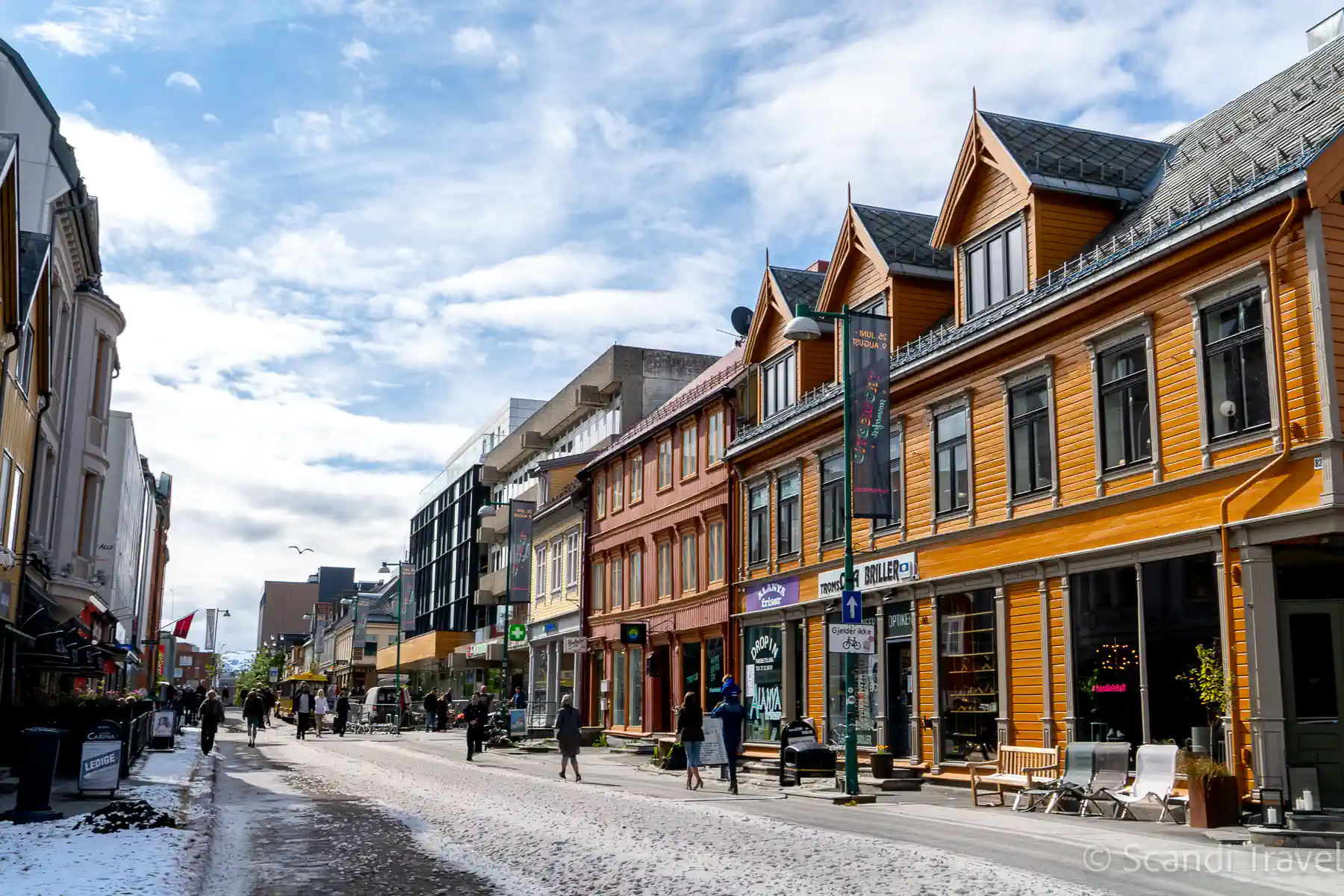
Tromsø in winter is a city of fjords, fishing boats and mountains that spend weeks at a time living in blue twilight.
Most travellers picture Finnish Lapland and Arctic Norway as rivals: pick the forest or pick the fjords. In reality, they sit a short flight or a single scenic bus ride apart, and together they are far better than either one alone. In this article, we’ll look at when Tromsø is at its best, what is genuinely worth doing there in winter, and the simple ways to fold it into one of our Lapland tours without turning your holiday into a logistics puzzle.
Scandi Travel has been building journeys across the North for many years, and “Can we add Norway?” comes up in almost every winter enquiry we answer. The honest answer is yes — and Tromsø is usually the first place we suggest. 🇳🇴
Why Tromsø in Winter Belongs on Your Lapland Itinerary
Finnish Lapland and Northern Norway share the same latitude and the same dark winter sky, yet they feel like different planets. Lapland is forest and silence: endless spruce, frozen lakes, and a dry, still cold that can sit at −25 °C for days. Tromsø plays in a completely different key.
It is a city of more than 70,000 people, built on an island ringed by peaks that drop straight into the sea. There is a university, a busy harbour, and cafés that stay full all through the dark months. People call it the Paris of the North, and the nickname is only half a joke.
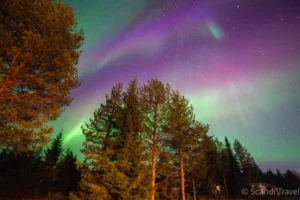
The two regions also cover each other’s weak spots. Inland Finnish Lapland tends to have steadier, clearer skies, which makes it one of the most reliable places in the Nordics to watch the aurora. Tromsø’s coastal weather moves faster and brings more cloud, but it offers what no forest can: fjords, whales, and mountains lit from below by the city. Visit both, and you get two very different chances at the Northern Lights — and two very different backdrops for them.
Then there is comfort. Tromsø lies roughly 350 kilometres north of the Arctic Circle, yet the Gulf Stream keeps its winters surprisingly mild, with an average winter temperature of around −4 °C. After a few days of deep Lapland frost, many guests find Tromsø’s waterfront almost balmy. The catch is wind and wet snow: −5 °C by the water can bite harder than −15 °C in a still Finnish forest.
When to Visit: Tromsø’s Winter Calendar 📅
Winter in Tromsø is not one season but several. The right week depends on what matters most to you: whales, light, culture or snow.
- November. Whale season usually begins in early November, when orcas and humpbacks follow the herring into the fjords north of the city. Snow can still be patchy at sea level early in the month, so dog sledding is best booked a little later in the winter.
- Late November to mid-January — the polar night. From around 27 November to 15 January, the sun does not rise above the horizon at all. Norwegians call this season mørketid, the dark time. It is rarely pitch black, though: a few hours of blue and pink twilight arrive around midday, and on clear days the southern sky looks like a sunset that never quite finishes. 🌌
- December. Peak whale season, the darkest skies, and a festive city dressed for Christmas. It is also the busiest month for Northern Lights tours, so book early.
- January. The sun officially returns around 15 January, but the mountains hide it from central Tromsø until about 21 January. Locals call it Sun Day and celebrate with hot chocolate and solskinnsboller, sweet vanilla “sunshine buns”. Whale season winds down by the end of the month, and the Northern Lights Festival, a music festival held across the city, usually runs in late January or early February.
- February. Sámi Week is built around Sámi National Day on 6 February. It brings a winter market, concerts, lasso throwing and the Norwegian Reindeer Racing Championships to Storgata, the main street. Days are noticeably longer, and it is one of the best months for outdoor activities.
- March. The spring equinox brings long, bright days, deep snow and nights that are still dark. It is ideal for snowmobiling, skiing and a relaxed aurora hunt without the December crowds.
If you are combining Tromsø with Finnish Lapland, this calendar lines up neatly with ours: all of our winter Lapland tours run in the same months, from November to March and April, so Tromsø can be added to practically any of them.
What to Do in Tromsø in Winter
The city is compact and easy to walk, and almost everything worth seeing lies within half an hour of the centre. These are the experiences we would build a Tromsø stay around.
Whale Watching in the Fjords 🐋
For about three months each winter, orcas and humpback whales gather in the fjords north of Tromsø to feed on overwintering herring. Since 2017, the action has centred on the Kvænangen fjords around the fishing village of Skjervøy. That is why most whale safaris take a full day: either a long boat journey from Tromsø, or a drive through the Lyngen Alps followed by a shorter trip out from Skjervøy. The season usually runs from early November to the end of January and shifts slightly from year to year as the herring move.
Fjellheisen and the View From Storsteinen
The Fjellheisen cable car rises from Tromsdalen, across the bridge from the island, to the Storsteinen ledge at 421 metres in about four minutes. From the top, the whole city lies below you: the island, the bridge, the harbour, and the mountains of Kvaløya in the distance. In winter, a shuttle bus runs from the centre to the lower station, and on clear evenings the viewing deck is one of the most popular spots in town to watch for the aurora. Go up once in the twilight and once after dark — they are two different views. 📸
The Arctic Cathedral
Completed in 1965 to a design by architect Jan Inge Hovig, the Arctic Cathedral is the building on most Tromsø postcards. Its stack of white concrete triangles is said to echo the wooden racks where cod is hung to dry into stockfish. It is a pleasant walk from the cable car, so the two fit naturally into one afternoon, and an evening concert inside is one of the quieter pleasures of a winter visit.
Sámi Culture and Reindeer 🦌
Tromsø lies within Sápmi, the homeland of the Sámi people, which stretches across Norway, Sweden, Finland and Russia. At reindeer camps outside the city you can ride a sledge, feed the herd and listen to stories inside a lavvu, the traditional Sámi tent — usually from autumn to early spring, while the herds are nearby. For a deeper look, the Arctic University Museum of Norway has two exhibitions on Sámi history and contemporary life. If your dates allow, Sámi Week in early February is the best time to see the culture celebrated in the city itself.
The Northern Lights, Norwegian Style
Tromsø is one of the busiest aurora-hunting bases in the world, and tours here don’t stand still — they drive away from the cloud. On a typical evening, minibuses head out to Kvaløya, towards the Lyngen Alps, or even across the Finnish border in search of a clear patch of sky. We have a full article on seeing the Northern Lights in Norway, including why Alta and the Lyngen Alps often have clearer skies than the coast, so we won’t repeat it here. The short version: a tour that follows the clear sky beats a trip to one fixed viewpoint.
The City Itself
It is easy to spend all your time in Tromsø outside the city, but the centre deserves an unhurried day. Tromsø has the largest collection of old wooden houses in Northern Norway, the oldest dating from 1789. The streets around the harbour are full of warm cafés, fish restaurants and bars where conversation carries on long after dark. In polar night, when “day” lasts a few hours, a long lunch overlooking the water is less an indulgence than a survival strategy. ☕
How to Combine Tromsø With Our Lapland Tours 🤝
This is where most people get stuck. On a map, Tromsø and Finnish Lapland look close, but there is no train between them, and the border runs through some of the emptiest country in Europe. In practice, four routes work well, and each pairs naturally with one of our tours.
Route 1: Fly From Kirkenes After Our 9-Day Finland to Norway Tour ✈️
Our 9-Day Lapland Tour: Finland to Norway Arctic Adventure, from €4,745, already ends in Norway. It travels from Helsinki by overnight train to Kemi, continues to Rovaniemi, then to Saariselkä and Sámi country, and finishes in Kirkenes with a king crab safari on the frozen fjord. Kirkenes is a small airport, so the journey home usually connects through a larger hub anyway — which puts Tromsø almost on the way.
Widerøe flies direct from Kirkenes to Tromsø several times a day on most days, and the flight takes about 1 hour 15 minutes. Add two or three nights in Tromsø, then fly home from its much larger airport, with direct connections to Oslo and, in season, to a number of European cities. For anyone already booked on the 9-day tour, this is the route we recommend first.
Route 2: Take the Arctic Route Bus Between Rovaniemi and Tromsø 🚌
If your Lapland tour is based in Rovaniemi, the most scenic way to reach Tromsø is by road. It works with any of these tours:
- 4-Day Finnish Lapland Tour in Rovaniemi, from €1,093
- 5-Day Northern Lights Tour with 4 nights in a glass igloo, from €4,245
- 6-Day Helsinki to Lapland Tour: A Finnish Fairy Tale, from €2,115
Throughout the winter, the Arctic Route bus connects Tromsø and Rovaniemi in a single day, stopping at Santa Claus Village, Kittilä, Levi, Muonio and Karesuvanto on the Finnish side. You change buses in Kilpisjärvi, right on the border, and the whole journey takes about 10 to 10.5 hours. That sounds long until you see it: the road climbs out of the Finnish forest onto open fells, crosses into Norway, and drops to the sea at Skibotn, where the Lyngen Alps rise across the fjord. There is also an overnight service, the Aurora Express, for travellers who would rather sleep through the transfer and watch for the lights from the window.
Two small but important details. Finland is one hour ahead of Norway, so check which time zone your timetable uses. And around New Year, the Finnish leg can be oversold, so book your seats at the same time as the rest of the trip.
Tromsø works as either a prologue or an epilogue. Fly into Tromsø from home, spend two or three nights by the fjords, and take the bus into Lapland the day before your tour begins — or reverse it and end your holiday by the sea.
Route 3: Fly Direct From Rovaniemi to Tromsø
If a full day on the bus feels too long, you can fly. Finnair operates direct flights between Rovaniemi and Tromsø, taking about 1 hour 20 minutes. The flights don’t run every day, and the schedule changes from season to season, but for any of our tours that start or finish in Rovaniemi, it is the fastest way to reach the fjords. In the morning, you are still in the capital of Lapland; by lunchtime, you are walking along Tromsø’s waterfront.
Route 4: Fly Direct From Helsinki to Tromsø
For tours that start or finish in Helsinki, a flight works well — for example, our 8-Day Northern Lights Tour to Rovaniemi and Inari, from €3,720. In season, Finnair runs a handful of direct Helsinki–Tromsø flights a week, taking just under three hours. Frequencies change from year to year, so this option suits flexible dates best. If the direct flight doesn’t fit, connecting via Oslo is the usual alternative.
We don’t currently sell a fixed Tromsø package, and that is exactly why we prefer to build this part individually. Tell us which tour you are considering and when, and our team will suggest the route, the number of nights and the activities that fit your dates.
Tromsø vs. Finnish Lapland: What Changes at the Border
The two halves of the trip are different enough that it helps to know what to expect before you arrive.
- Temperature. Tromsø averages around −4 °C in winter and rarely drops far below −14 °C. Inland Finnish Lapland regularly falls below −20 °C and can reach −30 °C.
- The kind of cold. Lapland’s cold is dry and still. Tromsø’s is coastal: wind, sleet and icy pavements. The numbers can mislead you in both directions.
- Landscape. Lapland gives you forest, fells and frozen lakes. Tromsø gives you fjords, sea and mountains rising straight out of the water.
- Aurora conditions. Both sit under the auroral oval. Inland Finland tends to have steadier skies, while in Tromsø you more often have to drive to find clear weather.
- Pace. Lapland is about activities and quiet. Tromsø is a proper city, with restaurants, museums, music and nightlife.
- Money and time. Norway uses the Norwegian krone rather than the euro. Cards are accepted almost everywhere, and prices run noticeably higher than in Finland. Norway is also one hour behind Finland.
What to Pack for Tromsø in Winter ❄️
Our Lapland winter packing list covers the core layering system, and all of it still applies. Tromsø simply adds a few coastal twists.
- A windproof, waterproof outer shell. This matters more in Tromsø than in Lapland. Wind off the fjord cuts through insulation that feels perfectly warm in a still forest.
- Ice grips or microspikes. Tromsø gets plenty of snow, and its hilly streets freeze and thaw again and again. Slip-on grips for your boots are cheap and genuinely useful.
- Waterproof insulated boots. Wet snow and slush at sea level, deep dry snow in the mountains — your boots need to handle both.
- Seasickness tablets. The open stretches on the way to Skjervøy can be rough in winter. Take them before you board, not once you start to feel it.
- A spare power bank. Cold drains phones and cameras fast, and the aurora rarely waits for you to recharge.
One practical note on the polar night: with so few light hours, plan outdoor sightseeing for the middle of the day and save museums, cafés and the cathedral for the dark afternoon. It is the rhythm locals live by all winter. 🌊
Frequently Asked Questions
Is Tromsø colder than Rovaniemi in winter?
Usually not. Thanks to the Gulf Stream, Tromsø averages around −4 °C in winter, while Rovaniemi and inland Finnish Lapland regularly drop below −20 °C. Tromsø does get more wind and wet snow, though, so it can feel colder than the thermometer suggests.
How do I get from Rovaniemi to Tromsø in winter?
The fastest option is a direct Finnair flight, which takes about 1 hour 20 minutes but doesn’t run every day. The alternative is the Arctic Route bus, which runs all winter and takes about 10 to 10.5 hours with a change in Kilpisjärvi. There is also an overnight bus, the Aurora Express.
How many nights should I spend in Tromsø?
Three nights is the sweet spot for most guests. That gives you one full day for whales or reindeer, one day for the city and the cable car, and at least two evenings to look for the Northern Lights in case the first one clouds over.
Can I see whales and the Northern Lights on the same trip?
Yes, if you travel between early November and late January. Whale safaris run during the day and Northern Lights tours in the evening, and on the way back from Skjervøy some guests see the aurora from the boat or the bus. Neither is ever guaranteed.
Do I need a separate visa for Norway?
Norway is not in the EU, but like Finland it is part of the Schengen Area, so there are no routine passport checks at the border itself. Entry rules still depend on your nationality, so check the current requirements with an official government source before you book flights.
Ready to Add Tromsø to Your Lapland Winter?
Finnish Lapland gives you the forest, the silence and nights under a glass roof. Tromsø gives you the fjords, the whales and a city glowing in blue midday twilight. You don’t have to choose between them, and you don’t have to piece the journey together alone. The team at Scandi Travel will gladly combine Tromsø with any of our tours, taking care of the transfer, hotels and excursions, and choosing the right number of nights in Norway for your dates. 🤝