Lapland in March is the same winter with the lights switched on. The spruces still bow under heavy caps of snow, and the ice on the lakes is half a metre thick. But by eight in the morning the sun is already above the forest, and at six in the evening it is only beginning to turn red. At midday you can sit by a campfire with your jacket unzipped, squinting against the glare. At night the frost drops below −10 °C again, and the sky above the same fire pit turns green.
Most travellers head north in December for Christmas or in January for the deepest dark. March stays in the shadows, even though Finns themselves consider it the best part of winter. They even have a word for it — kevättalvi, “spring winter”: the snow and frost are still here, but the darkness has gone. In this article, we’ll explain why the spring equinox is one of the best aurora windows of the year, what to do when there is daylight for everything, and how to fit March into our winter tours.
We at Scandi Travel live in Finland, and we watch this change happen every year. In February, every conversation is still about the cold. By mid-March, it is all sunshine, ski trails and where to grill sausages straight on the snow. If you have been putting Lapland off because −30 °C and endless night sounded like too much, March may be your month.
Why Lapland in March Is Winter’s Best-Kept Secret
The biggest thing March brings is light. In Rovaniemi, the day lasts about 10 hours on 1 March, around 11.5 hours by the 15th, and more than 13 by the end of the month. That is almost four extra hours in thirty days. After December, when the sun shows itself for a couple of hours or not at all, it feels like a different country.
Winter, though, isn’t going anywhere. Daytime temperatures in Rovaniemi usually sit between −2 and −5 °C, nights fall to −10…−15 °C, and on some nights in the far north the thermometer still drops below −30 °C. For activities, that is good news: the snow doesn’t melt, the lakes hold their ice, and huskies and snowmobiles run at full strength.
The snow cover is also at its deepest of the whole winter by March — often more than half a metre in Rovaniemi, and close to a metre in open parts of the north.
There is a third reason people mention less often: the sky. Together with September, March is statistically one of the most geomagnetically active months of the year — more on that below. And the nights are still dark enough to make the most of it.
To be honest about the downsides: if you dream of Christmas atmosphere, fairy lights and blue twilight at noon, that is December, not March. And the aurora window shrinks as the month goes on. In the last days of March, it doesn’t get properly dark until around 10 pm.
Northern Lights in Lapland in March: The Equinox Effect
Aurora watchers noticed long ago that the sky is more talkative in spring and autumn than in midwinter. In 1973, geophysicists Christopher Russell and Robert McPherron explained why. Around the equinoxes, the magnetic fields of the Sun and the Earth line up in a way that lets even a moderate solar wind slip into the magnetosphere more easily. The result is more geomagnetic storms, and stronger ones. Today it is known as the Russell–McPherron effect.
The numbers back this up. According to the British Geological Survey, a sizeable magnetic storm happens on nearly twice as many days in March as in June or July. Long-term records place March among the most geomagnetically active months of the year, alongside September and October.
One important caveat: the equinox effect doesn’t depend on the solar cycle. Solar Cycle 25 peaked in October 2024 and is now in decline, but the geometry of the equinox stays the same. It can’t create a storm out of nothing — yet the same burst of solar activity is more likely to produce a visible aurora around the equinox.
The flip side is timing. In early March, the sky over Rovaniemi gets dark by about 8 pm; by the end of the month, it is closer to 10 pm. So plan your aurora hunting for roughly 10 pm to 2 am, and don’t wear yourself out during the day so badly that you have no energy left to step outside at night.
As always, nothing is guaranteed: clouds don’t know about the equinox. The more nights you spend in the north, the better your chances — we recommend at least three or four.
For a closer look at how the odds change through the year, see our article on the best time to see the Northern Lights. And all our Northern Lights tours are gathered on one page.
Things to Do in Lapland in March
Long days change the rhythm of a trip. In December, everything has to fit into a few hours of light. In March, you can give half a day to a single activity, have lunch by a campfire, and still have the evening ahead of you.
Husky Safaris in Daylight
In March, the team runs through the forest in sunshine, and it is a completely different safari from one in blue December twilight: you can see every dog, every branch, and the shadow of the sled on the snow. The dogs love the crisp March frost, and the crusted snow holds well. If you’d like to get to know the dogs before your trip, we have a separate article on husky safaris in Lapland.
Snowmobiling Across Frozen Lakes
The ice is at its thickest of the year in March, and snowmobile routes run far across lakes and bogs that are impassable in summer. In bright sun the snow is dazzling, so goggles matter even more than in January.
Skiing and a Campfire at the Laavu
For Finns, March means cross-country skiing above all. Lapland has thousands of kilometres of groomed trails, and along them stand laavu — open wooden lean-to shelters with a fire pit and a supply of firewood. The classic March day looks like this: a ski trail, a stop at a laavu, sausages on the fire and coffee from a thermos.
No programme, just sun on your face and silence. If skiing isn’t for you, you can cover the same route on snowshoes.
Ice Fishing
Finnish pilkkiminen — sitting by a hole in the ice on a reindeer skin, waiting for a perch — turns from an endurance test into a pleasure in the March sun. Even if nothing bites, you’ll spend a couple of hours in the middle of a white lake in complete silence. We wrote about ice fishing and the icebreaker on the Gulf of Bothnia in our article on Kemi in winter.
Reindeer Racing
This is probably the most unexpected sight of March. A skier on a short rein, a reindeer at full gallop in front — up to 50 km/h across a frozen lake. Stages of the Poro Cup (Reindeer Cup) run across Lapland from mid-February, spectators warm up with reindeer soup, and lassos fly between heats. If your dates line up with a race near your route, it is well worth a couple of hours.
Sauna and Ice Hole at Sunset
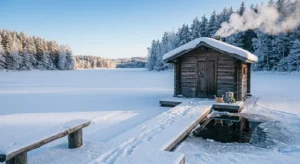
In December, you go to the sauna in total darkness. In March, the sun sets between six and eight in the evening, so you can step out of the steam onto the snow just as the sky over the lake turns pink. Then the ice hole, the heat again — and, if you’re lucky, the first green ribbon above the forest. We explain how a Finnish sauna works, and why you don’t need to jump into the ice hole, in our article on Finnish sauna culture.
A Night in a Glass Igloo
March nights are still dark enough for an igloo, and the mornings are something special: sunrise comes straight to your bed, and you wake up under the sun instead of a streetlamp. The only catch is that it gets light early, so pack a sleep mask if you like a lie-in. If you’re choosing between an igloo and a log cabin, our comparison Glass Igloo vs. Log Cabin will help.
Where to Stay in Lapland in March — and How to Fit It Into Our Tours
Our winter Lapland tours run until the end of March, and some programmes continue into April. Here is how the regions compare in March.
Rovaniemi is the easiest option: direct flights, everything close at hand, and noticeably calmer in March than in December. For a short trip, our 4-Day Finnish Lapland Tour in Rovaniemi is a good fit. If you’d like to spend several nights under a glass roof, choose the 5-Day Northern Lights Tour with 4 nights in a glass igloo.
Inari and Saariselkä lie further north: darker skies, fewer people, and Sámi culture close by. This is where the quiet of March is felt most. Our 8-Day Northern Lights Tour to Rovaniemi and Inari brings this part of the north together.
For those who want two countries in one trip, there is the 9-Day Lapland Tour: Finland to Norway Arctic Adventure. It ends in Kirkenes with king crab fishing straight from the ice of the fjord — and in March, that ice is still reliable.
You’ll find every programme in our winter Lapland tours section. If you’re unsure about dates, just write to us: we’ll tell you which weeks of March will be quietest.
What to Pack for Lapland in March
The basic layering system is the same as for any northern winter, and it is covered in detail in our Lapland winter packing list. March simply adds a few items of its own.
- Sunglasses. Item number one. Snow reflects up to 80% of UV radiation, and a couple of hours on an open lake in March sun is enough to bring on snow blindness (lumisokeus). For snowmobiling and skiing, ski goggles are better still.
- Sunscreen and lip balm. A northern tan is perfectly normal in March. So is a sunburnt nose.
- Layers, not one warm jacket. The difference between noon and midnight can reach 15 degrees. On the ski trail you’ll be peeling layers off; on the aurora hunt you’ll want every one of them back on.
- Thin gloves under your mittens. In the sun you’ll want to take your mittens off for a photo, and bare fingers freeze in the wind within minutes.
- A sleep mask. At the end of March the sun rises around half past six, and in an igloo or a room with light curtains it comes straight into your bed.
- A power bank. The cold still drains phones fast, especially at night while you wait for the aurora.
Frequently Asked Questions
Is there enough snow in Lapland in March?
As a rule, yes: in March the snow cover in Lapland is at its deepest of the whole winter. Short thaws can happen in March too, but further north, in Inari and Saariselkä, the snow usually holds firm well into April.
Can you see the Northern Lights at the end of March?
Yes. The window is shorter, roughly from 10 pm to 2 am, but the equinox effect raises the likelihood of geomagnetic activity in exactly these weeks. As in any other month, there are no guarantees.
Is March cheaper than December?
March is usually calmer and more affordable than the Christmas weeks. The exceptions are the Finnish school ski holidays in early March and Easter (26–29 March in 2027), when demand in Lapland rises again. Our team can give you exact prices for your dates.
Is March a good month for a trip with children?
It is arguably one of the best months for families. The frost is milder, there is enough daylight for both activities and rest, and children don’t have to wait until late at night for darkness before a sledge ride or playing in the snow.
Which is better: February or March?
February is darker and colder, but the nights are longer, so there is more time for the aurora. March is brighter and milder, with the equinox effect on the aurora’s side. If the Northern Lights are your main goal and the cold doesn’t scare you, choose February. If you want a balance between daytime activities and the night sky, choose mid-March.
Ready to See Lapland in Daylight?
December shows Lapland in darkness and lights, January in its harshest form. March shows all of it at once: knee-deep snow, sun above the forest, silence on the lake and, if you’re lucky, a green sky at night. It is winter for people who want winter without the extremes. The team at Scandi Travel will match the tour, the weeks and the base to your dates, so all that’s left for you is to step out onto the snow.