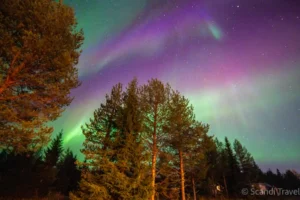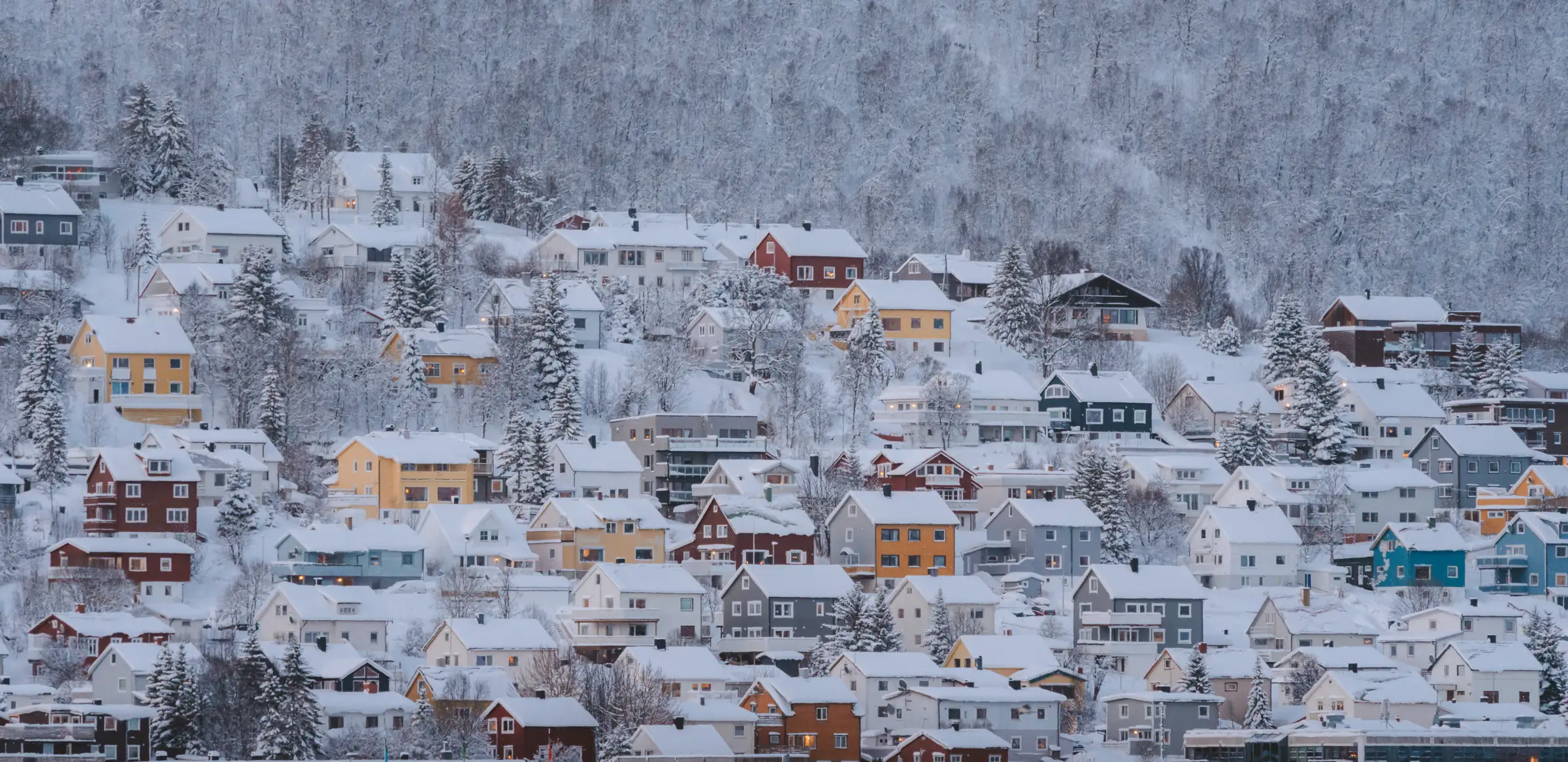
On the third night of this journey, you are warming yourself by a fire in a snow-covered Finnish forest, wrapped in a thermal winter suit, a mug of something hot in your hands, watching a sky that may or may not cooperate. Two nights later, you stand on a Norwegian shore, the fjord black at your feet, while your guide has just spent an hour outrunning a bank of cloud. Same latitude, same auroral oval — two completely different ways of waiting for the Northern Lights.
That is the idea behind our new Lapland and Tromsø tour: eight days that begin in Helsinki, cross the Arctic Circle on the overnight Santa Claus Express, and finish among the fjords of Arctic Norway. In this guide, we’ll look at why two countries give the aurora a fairer chance than one, which months suit the route best, what each day actually looks like, and how it compares with our other winter itineraries.
“Can we add Norway?” has been one of the most common questions in our winter enquiries for years. Until this season, the honest answer involved bus timetables, a border crossing and a fair amount of planning on your side. Now it is one booking, with every transfer arranged.
Why a Lapland and Tromsø Tour Gives the Aurora Two Chances
Seeing the Northern Lights takes two things at once: activity on the Sun and a clear patch of sky above you. Nobody can do anything about the first. The second is a matter of local weather — and that is where the two halves of this trip quietly work together.
Inland Finnish Lapland has a continental winter. The air is dry and still, the cold settles in for days at a time, and clear nights are common.
Tromsø sits on the coast, about 350 kilometres north of the Arctic Circle, where the Gulf Stream keeps winters mild and weather blows in off the sea far more quickly. Clouds come and go within hours. That is why aurora guides there don’t wait at a single viewpoint: they read the forecasts and drive towards the gaps, sometimes out to the islands, sometimes inland towards the Finnish border.
Those are two separate weather systems, roughly 400 kilometres apart in a straight line. A cloudy spell over Rovaniemi says very little about the sky over Tromsø two days later, and the reverse is true as well. It is not a guarantee — nothing about the aurora is — but it is a better spread of risk than spending every evening under the same patch of sky.
A word on the Sun, because we are asked every season. Solar Cycle 25 peaked in October 2024 and is now in its declining phase. Strong geomagnetic storms still happen during the decline, often some of the most memorable ones, and at this latitude a long, dark, clear night matters more than where we are in the cycle.
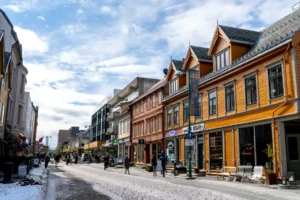
Then there is everything else. Lapland gives you the forest: huskies, reindeer, silence and snow squeaking underfoot. Tromsø gives you the coast: a city of more than 70,000 people, wooden houses on the harbour, cafés full through the dark months, and mountains that rise straight out of the sea. Add a day in Helsinki at the start, and it is a softer landing after a long-haul flight than going straight into −20 °C.
When to Take the Lapland and Tromsø Tour: November to April
The tour runs from November to April, and every month brings a slightly different trip. Here is how the season looks from both ends of the route.
- November. The quietest start to the season. Whale season usually opens in the fjords north of Tromsø in early November, which matters if you want to use your free day for orcas. Early in the month, snow can still be thin both in Rovaniemi and at sea level in Tromsø; by late November, it is usually settled.
- December. The darkest and most festive month. From around 27 November to 15 January, the sun doesn’t rise above the horizon in Tromsø at all — Norwegians call it mørketid, the dark time. Rovaniemi, right on the Arctic Circle, still gets just over two hours of low sun around the solstice. Santa Claus Village is at its most theatrical, Helsinki is lit for Christmas, and this is the month to book furthest ahead.
- January. Deep winter in Lapland, with days around −15 to −25 °C and colder nights possible, while Tromsø averages about −4 °C. The sun returns to Tromsø around 15 January, but the mountains hide it from the city centre until about 21 January, which locals celebrate as Sun Day. Whale season winds down by the end of the month.
- February. A classic aurora month: long nights, stable snow, and noticeably more daylight. Sámi National Day on 6 February anchors Sámi Week in Tromsø, with a market, concerts and reindeer racing along Storgata, the main street.
- March. Bright days, the deepest snow of the winter in Lapland, and the equinox, when geomagnetic activity tends to pick up. Our guide to Lapland in March explains why many Finns consider this the best part of winter.
- April. Early April still delivers snow, sunshine and dark hours late at night. After mid-April, though, the nights in Tromsø become too short and bright for reliable aurora watching, so treat late-April dates as a spring trip with an outside chance of the lights.
If you are asking us, mid-January to mid-March is the most balanced window: proper snow, real darkness and enough daylight to enjoy the fjord day. Choose December for Christmas, and November to January if whales are on your list.
Inside the Tour: Eight Days From Helsinki to the Fjords
The route covers about 1,150 kilometres, two countries and three stops, yet there is only one early start in the whole programme. The long legs happen while you sleep or take barely more than an hour in the air.
Days 1–2: Helsinki and the Santa Claus Express
A driver meets you at Helsinki Airport and takes you to a centrally located hotel. In winter, the Esplanadi is strung with lights, the market square sits right on the frozen edge of the sea, and a warm café is never more than a street away — a gentle first evening after the flight.
The next morning, a panoramic bus tour takes in Senate Square and its white cathedral, the Presidential Palace, Parliament, Finlandia Hall, the Opera House and the Church in the Rock, carved straight into the granite. The afternoon is yours. In the evening, a transfer brings you to the station, where the Santa Claus Express is waiting. You settle into a private cabin and the train carries you 875 kilometres north through the night, past frozen lakes and forest, towards the Arctic Circle.
Day 3: Huskies by Day, a Campfire by Night
You wake up in Rovaniemi. After a transfer to your hotel, the first big moment of the trip arrives quickly: a husky safari. The ranch announces itself long before you see it — dozens of dogs barking, leaping and straining at the lines, desperate to run.
After a briefing from the musher, you take the sled yourselves, two to a team, and the noise drops away the moment the dogs hit the trail. What’s left is the hiss of the runners and the panting of the pack. If you’d like to know the dogs before you meet them, we wrote about husky safaris in Lapland in detail.
In the evening, a guide drives you away from the town lights for the first Northern Lights search. Sausages on the fire, old Lapland stories about the aurora, and a wide, silent sky above a frozen landscape. If the sky is clear and the solar wind is blowing, this is where the first green curtain usually appears.
Day 4: Reindeer, the Arctic Circle and Santa Claus
After a hearty breakfast, a half-day tour begins. It starts at a reindeer farm, where a local herder introduces the animals and the culture that has grown up around them for centuries. Then comes a sleigh ride through the forest — about as quiet and unhurried as travel gets.
Next, the Arctic Circle crossing ceremony: one foot in, one foot out, and a diploma to prove it. The rest of the morning belongs to Santa Claus Village — cards posted from the Arctic Circle post office, and a visit to Santa’s office to meet Joulupukki himself. Lunch is included, and the evening is free in Rovaniemi.
Day 5: A Short Flight and a Long Chase
After breakfast, a transfer takes you to Rovaniemi airport for the flight to Tromsø, about an hour and twenty minutes of forest giving way to white mountains and then to the sea. One small thing to remember: Norway is one hour behind Finland, so you gain an hour on arrival.
As darkness falls, the Northern Lights chase begins. The route is chosen that evening, wherever the forecast promises a clear sky. Your guide explains the science and the legends, helps with camera settings and takes portraits of you under the lights, while a warm meal and hot drinks are served by the fire. Thermal suits and blankets are included, which is worth knowing: a chase can mean several hours outdoors.
Day 6: The Arctic Coast in Daylight
A full day among the fjords around Tromsø, where the mountains drop straight into the water. The guide follows the coast road past deep blue fjords and snow-covered peaks, stopping at the best viewpoints, through fishing villages with red boathouses and frozen harbours. Keep an eye out for sea eagles circling above the shore, reindeer on the roadside and, with luck, seals. A warm meal or snack is served along the way, and you are back in town in time for dinner.
Days 7–8: Tromsø at Your Own Pace
The last full day is free, and Tromsø fills it easily. Walk the wooden streets of the centre, take the Fjellheisen cable car up to the Storsteinen ledge at 421 metres for the view over the island and the bridge, or visit the Arctic Cathedral across the water. It is also the day to choose souvenirs without hurrying, the kind that will remind you of this trip for years: wool mittens and a sweater in a Norwegian pattern, handicrafts by Sámi artisans, stockfish from the fishing villages. On day eight, a transfer takes you to Tromsø airport for the flight home.
The free day can also go to one of the optional excursions we book for guests on the tour. The most popular is a whale-watching tour. From early November to the end of January, orcas and humpback whales follow the herring into the fjords north of Tromsø, and for that period we can book a whale-watching trip for you in advance. It is a full-day outing: in recent seasons the whales have gathered near the fishing village of Skjervøy, so the journey there takes a few hours by boat, or by coach and then boat.
Outside whale season, the same day works for another safari or a second Northern Lights evening — just let us know when you book.
For a wider look at the city — the polar night, Sámi Week, what to eat and where to go — see our guide to Tromsø in winter.
Finnish Campfire vs. Norwegian Chase: Two Ways to Hunt the Aurora
The two aurora evenings on this tour are not repeats of each other. They feel different from the first minute.
- The approach. In Lapland, you go to a quiet spot away from the lights and wait. In Tromsø, the guide moves with the weather and the group goes where the clear sky is.
- The landscape. Lapland gives you spruce, frozen lakes and a flat, open horizon. Around Tromsø, the lights hang over fjords and peaks, and on calm nights they are reflected in the water.
- The cold. A still, dry −20 °C in the Finnish forest, against a damp, windy −5 °C on the Norwegian coast. The second can feel just as cold.
- The rhythm. The Finnish evening is slow: fire, stories, patience. The Norwegian one is more of a road trip, with time in the minibus between stops.
- The photos. Both guides help, but the Tromsø chase includes portraits taken by your guide — useful if you’d rather be in the picture than behind the camera.
Our advice is simple. Treat the Lapland evening as your first real chance, and the Tromsø chase as the second. If the sky gives you a show on both, you will have seen the same light over two completely different worlds.
Where You’ll Sleep: Three Cities and a Train Cabin
The Lapland and Tromsø tour has seven nights, and only one of them is unusual: the night on the train. Everything else is a centrally located 4-star hotel with breakfast included, on a double or twin basis.
- Helsinki — 1 night. A hotel right in the heart of the city.
- Santa Claus Express — 1 night. A private cabin on the overnight train from Helsinki to Rovaniemi.
- Rovaniemi — 2 nights. A hotel in the city centre.
- Tromsø — 3 nights. The longest stop on the route, so you unpack properly once and have the city on your doorstep.
Our main hotel partners across Finland and Norway include Lapland Hotels, Santa’s Hotels, Scandic, Sokos, Clarion and Thon. We also work with a wide range of more unusual places to stay, from glass igloos to log cabins in the forest.
If you dream of a night under a glass roof in Lapland, an extra night anywhere on the route or a different hotel category, write to us — we tailor itineraries regularly. Our comparison of a glass igloo vs. a log cabin can help you decide whether the igloo is worth it for you.
What to Pack for Two Kinds of Arctic Cold
Packing for a Lapland and Tromsø tour is slightly unusual: you need to be ready for dry, deep frost in Finland and for wind and wet snow on the Norwegian coast. The good news is that you don’t need a full Arctic wardrobe. For the safaris in Rovaniemi, we provide the complete winter outfit, and in Tromsø the Northern Lights chase includes thermal suits and blankets. The core layering system is covered in our Lapland winter packing list; this route adds a few items of its own.
- Thermal base layers. Merino wool or synthetic, top and bottom. They are the one layer you bring for the Lapland safaris yourself.
- A windproof, waterproof outer shell. For the fjord day and the free day in Tromsø, where wind off the water cuts through insulation that feels perfectly warm in a still forest.
- Ice grips for your boots. Tromsø’s hilly streets freeze and thaw again and again. Slip-on grips are cheap and save a lot of careful shuffling.
- Insulated, waterproof boots. Dry powder in Lapland, slush at sea level in Norway — one pair has to handle both.
- A small overnight bag for the train. Toiletries and tomorrow’s base layers are easier to reach here than in the big suitcase.
- A power bank. Cold drains phones and cameras fast, and the aurora rarely waits while you recharge.
One practical note: Norway uses the Norwegian krone rather than the euro. Cards are accepted almost everywhere, but expect prices in Tromsø to run noticeably higher than in Finland.
Frequently Asked Questions
Are the Northern Lights guaranteed on this tour?
No — no honest operator can promise them. What the tour does is give you two dedicated aurora evenings in two different weather systems, plus seven nights above or near the Arctic Circle in total, which is a much better position than a single evening in one place.
How much does the Lapland and Tromsø tour cost, and what is included?
The tour is priced from €5,495 per person, two sharing. That includes seven nights with breakfast, the private train cabin, the Rovaniemi–Tromsø flight, all private transfers, the Helsinki city tour, the husky safari, both aurora evenings, the Santa Claus tour with lunch, and the fjord day. International flights, meals not mentioned in the programme and travel insurance are not included.
Which flights should I book to and from the tour?
The tour starts in Helsinki and ends in Tromsø, so look for an open-jaw ticket: into Helsinki, home from Tromsø. Tromsø has direct flights to Oslo and, in season, to several European cities, so the journey home usually needs only one connection. If it helps, we can also arrange your flight from Tromsø to Oslo — just mention it when you book.
How is this different from your 9-Day Finland to Norway tour?
Our 9-Day Lapland Tour: Finland to Norway Arctic Adventure, from €4,745, travels overland through Rovaniemi and Saariselkä, deep into Sámi country, and ends in Kirkenes on the Barents Sea with a king crab safari. The Lapland and Tromsø tour flies you to Norway’s largest Arctic city instead, trading the long road north for fjords, mountains and three nights in Tromsø.
Can I add whale watching?
Yes, on the free day, as long as you travel between early November and the end of January, when orcas and humpback whales follow the herring into the fjords north of Tromsø. It is a full-day trip, so tell us in advance and we’ll book it for you.
Do I need a separate visa for Norway?
Norway isn’t in the EU, but like Finland it is part of the Schengen Area, so there are no routine border checks on the flight between the two. Entry rules depend on your passport, so check current requirements with an official government source before you book.
Ready to See the Aurora in Two Countries?
Lapland gives you the forest, the dogs and a fire under an open sky. Tromsø gives you the fjords, the coast and a city glowing in blue midday twilight. For a long time, putting the two together meant a day on the bus and a stack of separate bookings; now it is eight days, one booking and two chances at the lights. The team at Scandi Travel has been building Nordic journeys since 2011, and we’ll gladly match the dates to the season you have in mind.