Written by Mikko Lintunen
In a nutshell
The Northern Lights occasionally make sounds, crackling, hissing, faint popping, audible to the human ear. Scientists dismissed this as folklore for over a century. A Finnish researcher proved them wrong in 2012. It happens in roughly 5% of strong displays, under very specific conditions. I have heard it once in fifteen years of watching the lights. Here is what it sounded like.
For a complete guide, visit our Northern Lights Travel Guide.
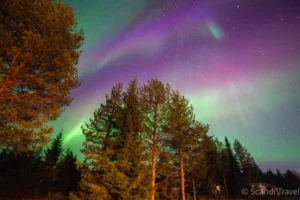
It was February, north of Rovaniemi, on one of the clearest nights of that winter. The temperature was -26°C. I was standing in a clearing well away from any road, watching a display that had been building for about forty minutes. At some point I stopped thinking about the lights and started noticing the silence. And then, underneath the silence, something else.
A faint crackling. Not continuous. Three or four times over maybe ten minutes. Like someone folding a very stiff piece of paper, very slowly, just out of sight. Then nothing.
I have been outside in Finnish Lapland watching the Northern Lights in every season and most weather conditions since 2010. That was the only time I heard them.
I want to tell you about the most overlooked thing the Northern Lights do.
The Sami knew before the scientists did
One of the Sami words for the aurora is guovssahas, which translates as “light you can hear.” Not “light in the sky.” Not “dancing light.”
Light you can hear.
The Sami had named this quality of the aurora centuries before any scientist with a microphone arrived to confirm it. They were, as is so often the case, paying closer attention than anyone else.

I keep coming back to this. Centuries of observation, encoded in a single word. Sometimes I think the whole history of science is just catching up to what people in cold places already knew.
For most of the twentieth century, the scientific community’s position was that the sounds were impossible. The aurora happens at altitudes of 100 kilometers or more. The atmosphere at that height is far too thin to carry sound waves down to the ground. The reports were folklore. People were imagining things. The imagination was particularly active in the Shetland Islands apparently, where in the 1930s readers of the local newspaper wrote in describing the lights as sounding like “lustering silk,” “burning dried juniper,” and, in one memorable account, “two planks meeting flat ways, not a sharp crack but a dull sound, loud enough for anyone to hear.”
I love that description. Whoever wrote that letter had never heard anything quite like it and found the most precise comparison they could. That is good witnessing.
These were not people prone to invention. They were islanders who had grown up with the lights overhead and noticed something specific. Of 114 responses to one survey conducted during the same period, 92 expressed belief in the sounds, and 53 claimed to have heard the noises themselves, according to the Royal Society. The scientific community remained unconvinced.
The Finnish researcher who listened
In 1990, a young Finnish acoustic scientist named Unto Laine took a break during a jazz festival in the far north of Finland. He stepped outside into a cold, still night, and heard a hissing sound above his head that seemed to move with the aurora overhead. He spent the next two decades trying to prove what he had heard.
In 2012, Laine released the first confirmed recording of auroral sounds, the culmination of years of monitoring the aurora from his home village of Fiskars, according to NBC News. He is Professor Emeritus at Aalto University in Finland, and using independently measured geomagnetic data, he showed he could predict when auroral sounds would occur in his recordings with 90% accuracy, according to Science Alert.
The sounds were real. They had always been real. Laine had simply been patient enough, and Finnish enough, to go out in the cold and listen.
So where do the sounds actually come from?
Not from the aurora itself. That part the sceptics had right.
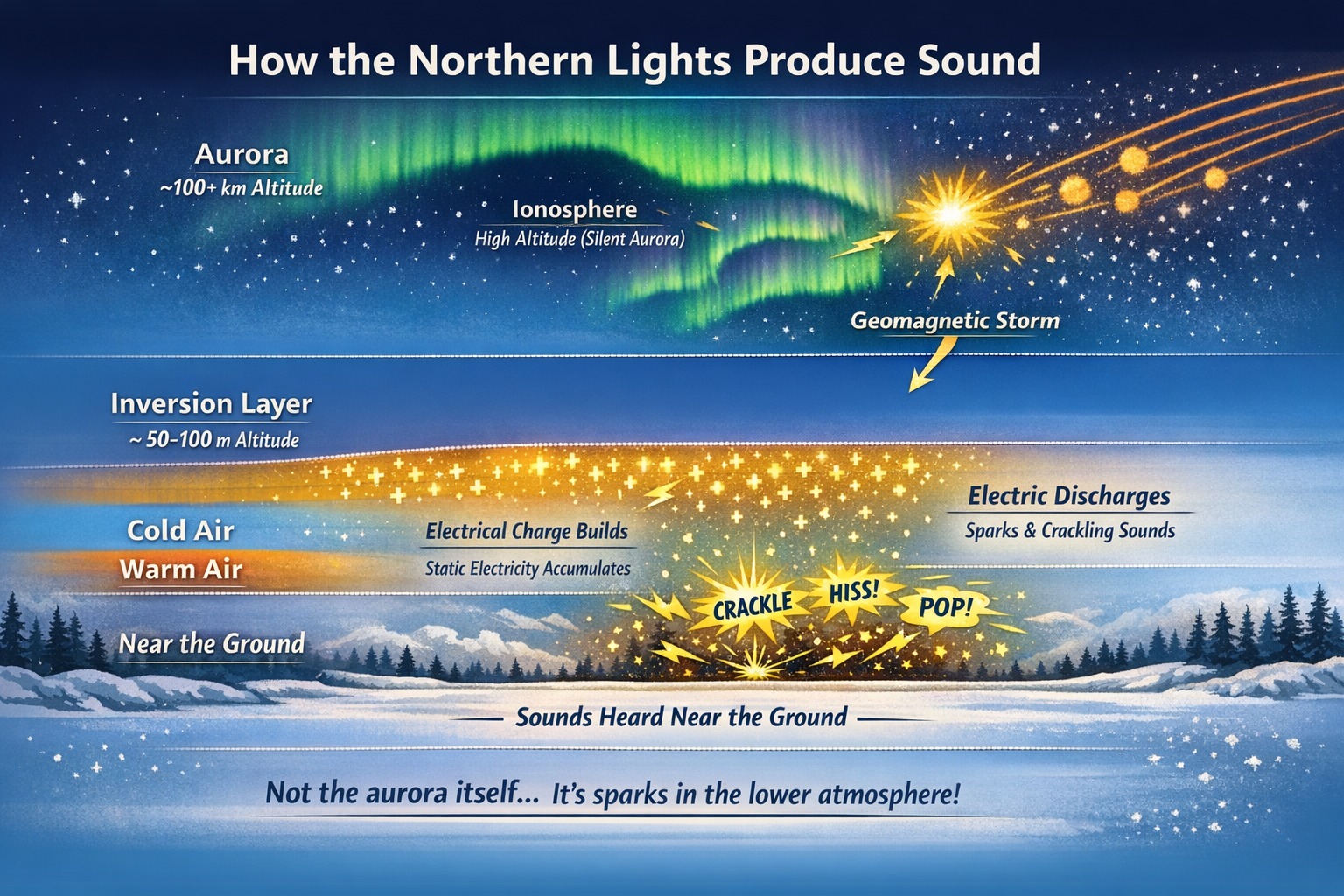
The lights are too high, the atmosphere too thin. The sounds originate from only about 70 meters above the ground, roughly the height of a tall building. During cold, calm nights, a temperature inversion layer forms in the lower atmosphere: warmer air trapping colder air at the surface. When a geomagnetic storm occurs overhead, electrical charges accumulate in this inversion layer and discharge as sparks. Those discharges, close enough to the ground to carry through the air, are what you hear.
The aurora and the sounds are not the same phenomenon. They are two separate effects of the same solar event, happening simultaneously at vastly different altitudes.
Professor Laine describes the sounds as crackles and muffled bangs, typically between 20 and 40 decibels, roughly the volume of a whisper, though occasionally reaching around 60 decibels, comparable to ordinary conversation a few meters away, according to Nautilus. They are only audible in roughly 5% of violent auroral displays, according to Live Science.
To make this easier to visualise, the diagram below shows how these two processes sit on top of each other in the atmosphere. The aurora itself forms high above, in the ionosphere, where the air is far too thin for sound to travel. Much closer to the ground, however, a shallow inversion layer can trap electrical charge during cold, still conditions. When that charge discharges, it produces the faint crackles and hisses people occasionally hear. What looks like a single phenomenon is in fact two linked layers: silent light overhead, and small, audible electrical events just tens of metres above you.
What you need to hear them
The conditions are specific. You need a strong geomagnetic storm, a very cold night, still air, no wind, and no ambient noise. You need to be away from buildings and roads. And you need to stop talking.
Laine notes that people often miss the sounds because they are chatting or taking photographs. “One has to listen very carefully,” he says, “to hear them and to distinguish them from the ambient noise,” according to Nautilus.
In Finnish Lapland in February, in the wilderness, this is achievable. In a car park in Tromsø with eleven other people, it is not.
I say this without judgment. I have been that person in the car park.
One more thing: recent research by Laine has found that the sounds occur even on nights when the aurora is not visible to the naked eye, according to Science Alert. The lights and the sounds are related but separate. You might, on a dark and apparently quiet night in the Arctic, be hearing the Northern Lights without seeing them at all.
Have I heard them since?
No. Fifteen years, hundreds of nights outside, one time. I am not sure whether that makes the memory more or less reliable. I know what I heard. I also know that -26°C does things to your perception of silence that warmer temperatures do not.
But Laine heard it at a jazz festival in 1990 and spent twenty years proving it was real. I think about that sometimes when guests ask me whether the lights make a sound. The Sami named them guovssahas. A Finnish scientist listened for two decades to confirm it. And on one very cold, very still February night north of Rovaniemi, I heard something that sounded like slowly folding paper, and I have never quite forgotten it.
Listen for yourself
The wilderness north of Rovaniemi at -26°C is as quiet as anywhere on earth. No wind. No road noise. No other voices. Just the ice settling beneath your feet and, on the rarest of nights, something faint and extraordinary above your head.
That silence, and everything that can happen inside it, is what a night in Finnish Lapland actually feels like.
Our 12-Day Northern Lights and Scandinavia Tour takes you there by the most beautiful route possible: overnight train from Helsinki through the dark Finnish interior, arriving in Lapland at dawn. Three nights in the wilderness, a glass igloo, a husky team in silent forest, and enough still, cold, dark sky to give you a genuine chance of hearing what the Sami named a thousand years before science caught up. For a tailor-made itinerary, contact us. A personal offer within 24 hours.
For the complete guide to timing, locations, and what to expect, visit our Northern Lights Travel Guide.
Hei hei from me and the team at Scandi Travel.