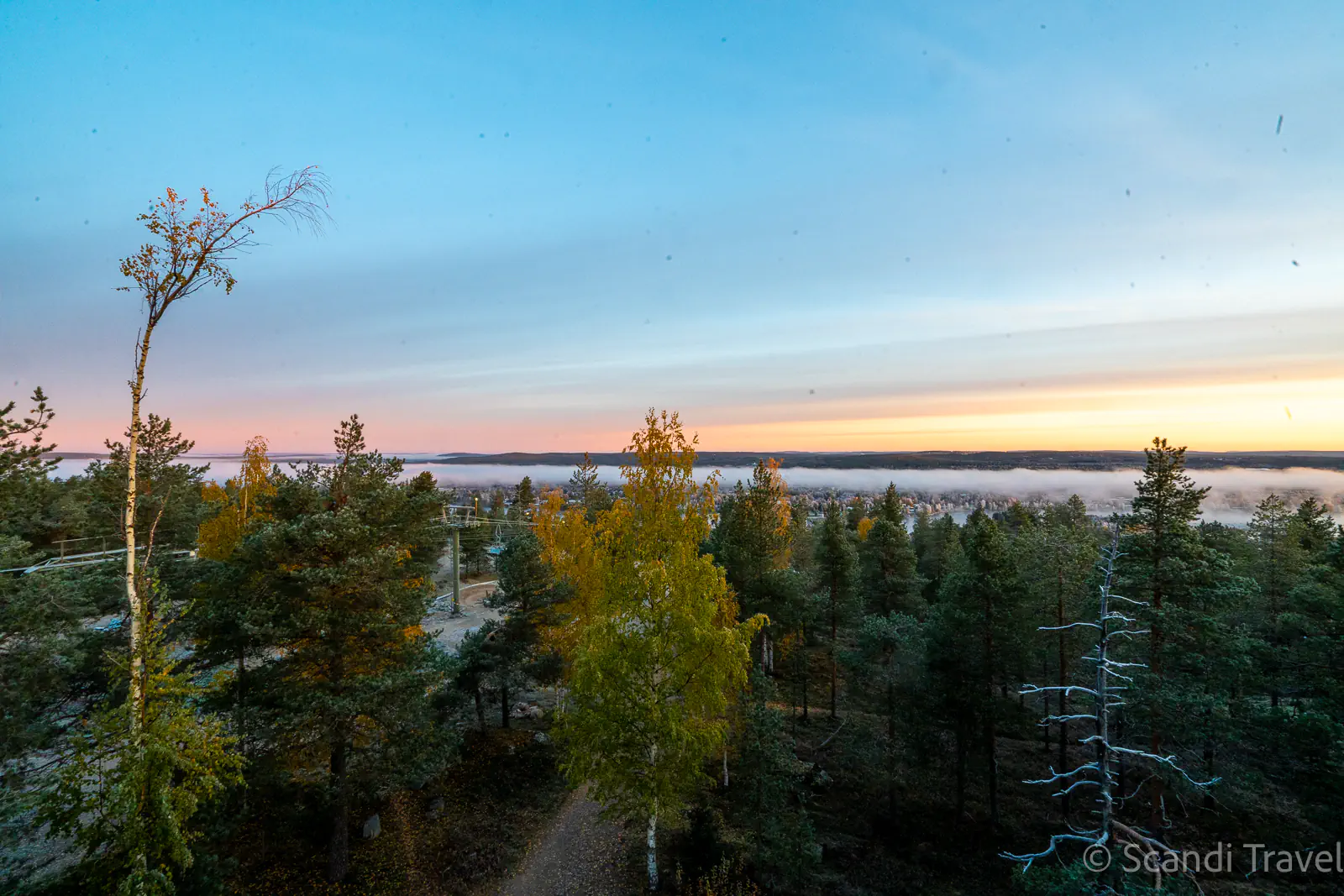
The forest floor turns first. Before a single birch leaf has changed, the low carpet of bilberry shrubs on a Lapland fell has already gone the colour of embers — and if you are standing on the ridge above Pallastunturi at the right week in September, it looks less like a hillside and more like the ground is quietly on fire. Most people picture Lapland white. For about two weeks a year, it is red.
This is ruska — the short, intense autumn colour season that sweeps across Finnish Lapland every September, and that most long-haul travelers have never heard of, let alone timed a trip around. In this guide, we will cover exactly when ruska happens in 2026, which national parks reward the effort of getting there, and why the same dark nights that light up the forest are also the first nights of the season you can catch the aurora.
Scandi Travel’s guides live with this season every year, and we get the same question every August: is it worth coming for two weeks of leaves? Every one of them would tell you the same thing — it is the quietest, cheapest, and in some ways the most photogenic fortnight Lapland has to offer. 🌲
Why Ruska Is Finnish Lapland’s Best-Kept Secret
Ask a Finn what ruska means and you will usually get a small, involuntary smile before the explanation. It is the word for the two or three weeks each autumn when the birch, aspen, and rowan forests — and especially the low mountain-avens and bilberry scrub on the open fells — turn through yellow, orange, and a deep, almost lacquered red, all at once, all over the north.
It is not a single day, like a “leaf peeping” postcard moment further south. It is a rolling wave: color begins in the far north, around Utsjoki and Inari, and moves south at roughly 500 kilometres in a couple of weeks, reaching Rovaniemi a few days after it has already faded above the Arctic Circle. Chase it correctly and you can, in theory, follow the color south for most of a month.
Locals treat it the way the rest of Europe treats a good wine harvest — worth planning around, worth taking a day off for. The traditional ruskaretki, or “ruska hike,” is a real cultural fixture: a day pack, a thermos, a fire permit, and no particular hurry to get anywhere. We are not selling you a gimmick when we build autumn itineraries around it — we are borrowing something Finnish families already do every year.
What makes it rare for visitors is timing, not access. Ruska in Finnish Lapland lasts roughly ten days at its peak in any single location, which is short enough that most travel guides skip it entirely in favor of the safer, longer winter and summer seasons. That is precisely why the fells are near-empty in September, even as the colors going up around you are arguably the most dramatic Lapland produces all year.
There is also a quieter reason photographers keep coming back. This far north, the sun barely climbs above the horizon by late September — which means the low, warm light that further south lasts twenty minutes at sunrise stretches across most of the afternoon here. Ruska is, in effect, a season-long golden hour laid over a landscape that is already red and gold to begin with.
When to See Ruska in Lapland: The 2026 Calendar 📅
Ruska is not a fixed date — it depends on frost timing and rainfall — but the pattern repeats closely enough each year that a week-by-week calendar is genuinely useful for booking flights.
- Late August. The quiet build-up. Nights are properly dark again for the first time since May, days are still mild, and the very first birches at the highest, most exposed fell-tops start to blush yellow.
- First week of September. Color spreads fast across Lapland’s fells and reaches the birch forests below the tree line. Rovaniemi and Saariselkä are still mostly green; Inari and Utsjoki, further north, are turning.
- Second week of September. Peak ruska across most of Finnish Lapland — typically the single best window, lasting about ten days. This is the week our guides tell friends to actually book.
- Third week of September. Peak color has moved south toward Rovaniemi and Levi, while Inari and the far north are already thinning toward bare branches.
- Late September into early October. Ruska fades in Lapland proper and hands off to southern Finland, where Koli and the lake district pick up the color for another few weeks.
Daytime temperatures through this stretch typically run from +15 °C down to +5 °C, with clear nights dropping close to freezing by late September — cold enough to be exactly what triggers the color change, mild enough that you are hiking in a fleece, not a parka.
There is a bonus most first-time autumn visitors do not expect: the nights are dark enough again by late August for the Northern Lights to reappear after the bright white nights of summer. It is genuinely possible to stand on a fell at 11 p.m. with green light overhead and rust-colored forest below you, waiting on sunrise to see the same hillside in daylight.
Nobody can promise a display on any given night, but late ruska season is one of the few windows in the entire year where color and aurora genuinely overlap. Most travelers only discover this by accident, on a trip booked for the leaves alone.
Where to Chase the Colors: The Best Parks and Trails
Not every fell earns the drive. These four are where our guides send their own families when the leaves start turning.
Pallas-Yllästunturi National Park
Finland’s most-visited national park outside summer, and for good reason — the classic Hetta–Pallas trail runs about 55 kilometres across open fell terrain with almost no tree cover, which means the ruska color is visible in every direction at once rather than glimpsed between trunks. You do not need to hike the whole route; day sections from Pallastunturi fell give you the same open panorama in a few hours.
Urho Kekkonen National Park
Finland’s second-largest national park, reached from Saariselkä, and considerably wilder. The hike to Lake Luirojärvi is the one locals recommend first — a full day out into genuine backcountry, with a wilderness hut at the far end for anyone extending it into an overnight trip. This is where to go if Pallas feels too well-trodden.
Kevo Strict Nature Reserve
The furthest north of the four, near Utsjoki, and the most dramatic. The Kevo Canyon trail runs roughly 63 kilometres along one of Finland’s most striking gorges, with the Kevojoki river cutting far below the rim. Because it is this far north, it also catches ruska first — usually a week or so ahead of Rovaniemi — so it is the place to go if you have arrived slightly early and want a head start on the color.
Levi
The easiest option, and the most social. Levi’s fell is accessible by chairlift, so you get the wide ruska view without committing to a full-day hike, and the resort hosts the Ruskamarathon in mid-September — a running festival that draws visitors specifically for the season, if you would rather share the trail with a crowd than have it to yourself.
More Than Hiking: Foraging, Rivers, and the First Auroras 🌅
Ruska season is also, not coincidentally, the best foraging window of the year. Under jokamiehenoikeus — Finland’s Everyman’s Right — anyone can pick wild berries and mushrooms on public and private land alike, no permission needed. Bilberries (the Nordic wild blueberry) peak in late August, lingonberries carry through September, and chanterelle and porcini season overlaps almost exactly with peak ruska. A ruska hike with a berry container in your pack is not an optional extra — it is how Finns actually do this.
The rivers are also at their best. Water levels are lower and calmer than spring melt, days are still long enough for a full afternoon on the water, and a canoe trip along a Lapland river during ruska puts you at eye level with reflections most hikers never see from the fell tops.
Wildlife is more visible too. Reindeer are moving down from the high fells ahead of the rut, and photographers regularly report better luck with both reindeer and, further east, brown bears in September than at almost any other time of year. 🦌
If cameras are the whole point of your trip, plan your days around that long, low afternoon light rather than the clock. A ridge that looks unremarkable at noon in July can be extraordinary at 3 p.m. in September, once the sun sits close to the treeline and every birch trunk throws a long shadow across the ruska color.
Our guides tend to build in deliberately slow afternoons for exactly this reason. The best frame of the trip rarely comes from rushing to the next stop — it comes from sitting still until the light does something worth pointing a camera at.
And then there is the aurora angle again, worth repeating because so few visitors plan for it: late ruska season, from roughly the second week of September onward, is realistically the earliest point in the year you can combine golden forest during the day with the first Northern Lights safaris of the season after dark. Solar Cycle 25 is now past its October 2024 peak and gradually declining, but strong individual flares still occur well into the decline — the odds are never guaranteed, but the dark, clear autumn skies over Lapland remain some of the best on the planet for trying.
Where to Base Yourself for Ruska Season
The right base depends on how much wilderness you actually want between you and your bed.
Saariselkä and Inari sit right at the edge of Urho Kekkonen National Park, and Inari — the Sámi cultural capital of Finland — adds a dimension no other Lapland base offers: the Siida museum, and a chance to understand reindeer herding culture as more than a tourist photo op. This is our pick for travelers who want the wilderness of ruska paired with genuine cultural depth. Trailheads here are a short drive away rather than a long one, which matters when daylight is already shortening.
Rovaniemi makes sense if you are combining ruska with city comforts or an early Arctic Circle visit — it also hosts autumn cultural events, from architecture-focused Alvar Aalto Week to Rovaniemi’s own late-summer festival calendar, so there is more happening in town than in high winter. It also sits closest to the airport, which suits anyone building a shorter, city-anchored version of this trip.
Accommodation across both follows the same partner network Scandi Travel uses year-round — Lapland Hotels, Santa’s Hotels, Scandic and Sokos all run properties in these towns, so the comfort level does not drop just because you have swapped the season.
Ruska also pairs well with a longer Nordic loop, since late September still has enough daylight and mild weather for city stops elsewhere in the region. Guests who do not want to fly home straight from Rovaniemi often bookend their Lapland days with Helsinki, Stockholm, or Tallinn — the same route our Nordic multi-country tours use for winter, just with a very different color palette outside the window.
What to Pack for Ruska Season
This is, by a wide margin, the easiest packing list Lapland asks of you all year — no Arctic-grade outerwear required.
- A waterproof, breathable shell jacket. September in Lapland is not usually wet, but a sudden shower on an exposed fell with no tree cover is common enough to plan for.
- A mid-layer fleece. Daytime temperatures of +10 to +15 °C feel colder on an open ridge with wind, so a layer you can add or shed matters more than one thick coat.
- Sturdy, broken-in hiking boots. Trails through Pallas-Yllästunturi and Urho Kekkonen mix dry fell rock with genuinely boggy stretches — ankle support and a real waterproof lining both earn their keep.
- A hat and light gloves for evenings. Clear nights drop close to freezing even while days are mild, especially if you are staying out for a late-season aurora check.
- A berry container or small bag. If you plan to forage even casually, you will regret not bringing one about an hour into your first hike.
One note from our guides: pack a headlamp even in early September. Darkness returns fast this far north, and an evening hike that starts in daylight can end well after sunset by the time you are back at the trailhead. 📸
Frequently Asked Questions
What are the best dates to see ruska in Finnish Lapland in 2026?
Based on the typical pattern, the second week of September is the safest bet for peak color across most of Lapland, with the far north around Utsjoki and Inari usually turning about a week earlier and Rovaniemi and Levi a week or so later.
Can you really see the Northern Lights during ruska season?
Yes — nights are dark enough for aurora viewing from late August onward, which overlaps with the tail end of ruska. No operator can guarantee a display on any specific night, but the combination of clear autumn skies and returning darkness makes September one of the better windows of the year to try.
Is ruska season crowded compared to winter in Lapland?
The opposite, if anything. Ruska falls outside the main winter and summer booking windows, so trails, hotels, and restaurants are noticeably quieter — one of the main reasons our guides recommend it to travelers who have already done a busier winter trip.
Do I need permits to forage berries or mushrooms during ruska?
No. Finland’s jokamiehenoikeus, or Everyman’s Right, allows anyone to pick wild berries and mushrooms on almost any land, public or private, without asking permission — one of the more pleasant surprises for first-time visitors.
Is a ruska trip suitable for families with children?
Very much so. Temperatures are mild, trails around Pallastunturi include short, manageable sections, and foraging turns a hike into a game for most kids well before they notice the distance covered — it is one of the easiest seasons to plan a family vacation in Lapland around.
Ready to See Lapland in Its Other Season?
Winter gets Lapland’s postcards. Ruska gets its own two-week secret, and it rewards travelers who would rather have a fell mostly to themselves than share one with a coach tour. If you would rather not gamble on peak dates alone, the team at Scandi Travel has been building Nordic trips since 2011 and can time your visit to the color, not the calendar. 🤝